AI-powered process automation
Skilled people are getting harder to find. To keep growing with the team you have, you need to make the most out of every working hour. Automation does that: your software takes over the repetitive tasks, and your team gets that time back for work that actually needs them.
Adding AI to your existing automations takes this further. AI can handle tasks that used to need a person, like reading documents, making judgement calls or answering questions.
We find the processes where you gain the most and automate them with AI so you get less manual work, fewer errors, faster decisions and lower costs.
AI picks up where "classic" process automation stops
Process automation is the foundation for any AI automation. Rule-based automations already save your team a lot of time. AI builds on top of them to handle the tasks fixed rules can't.
AI only adds value when it's embedded in your processes. When it’s Built into your ERP and works alongside your existing automations, it can run tasks for your team and help you gain time and productivity.
That's also why AI shouldn't be the first step. What it can do depends on how your processes already run. Most businesses sit somewhere in one of four stages.
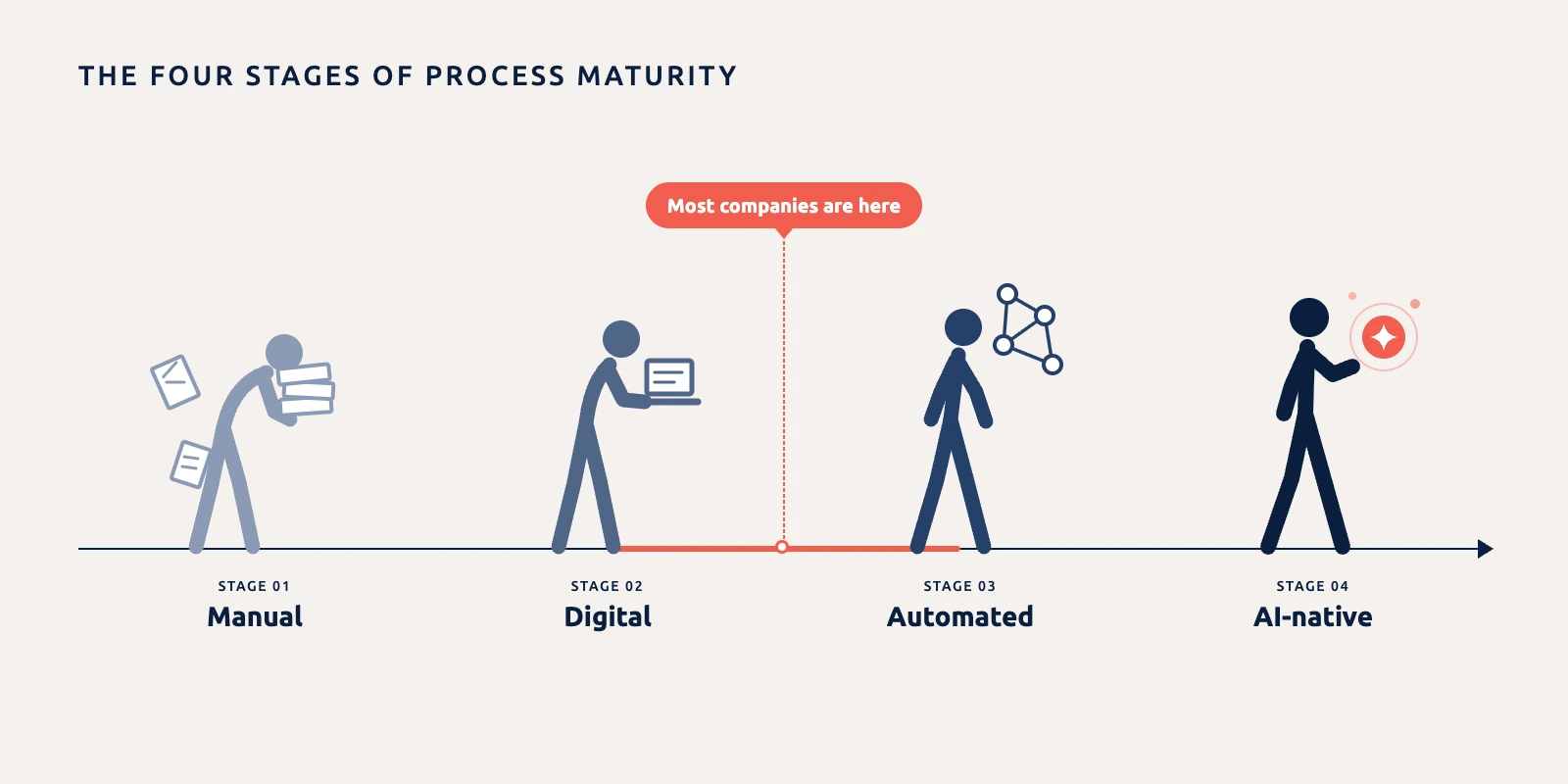
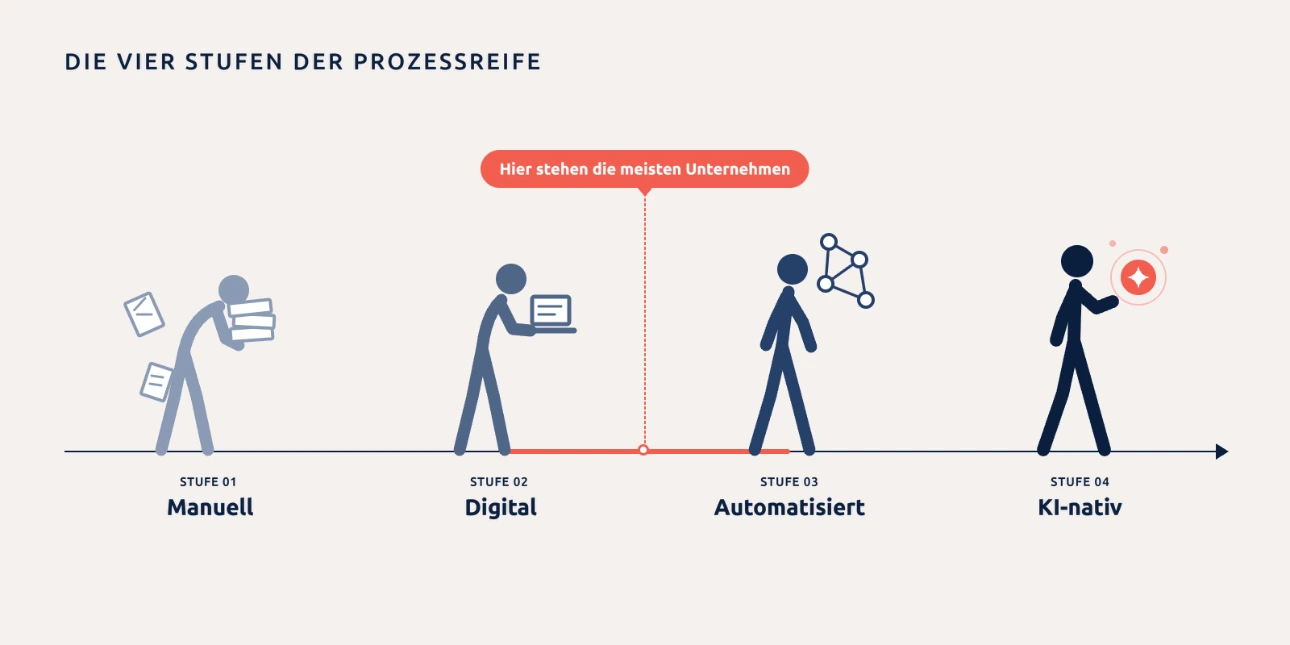
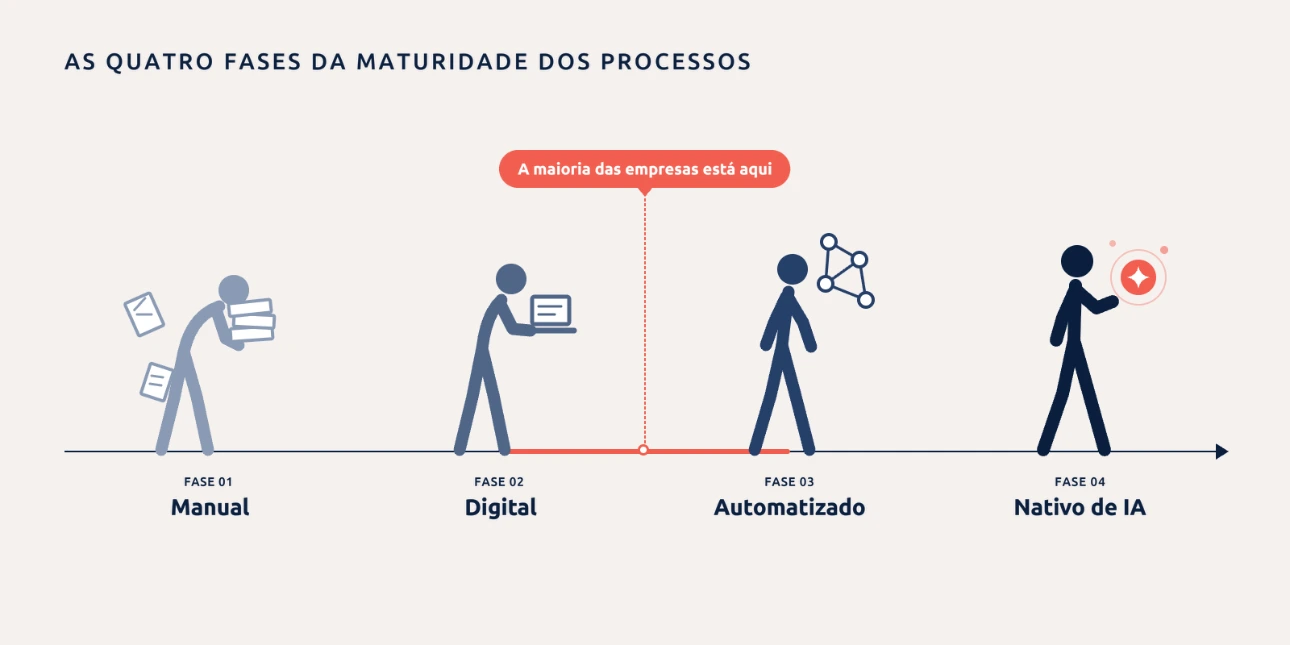
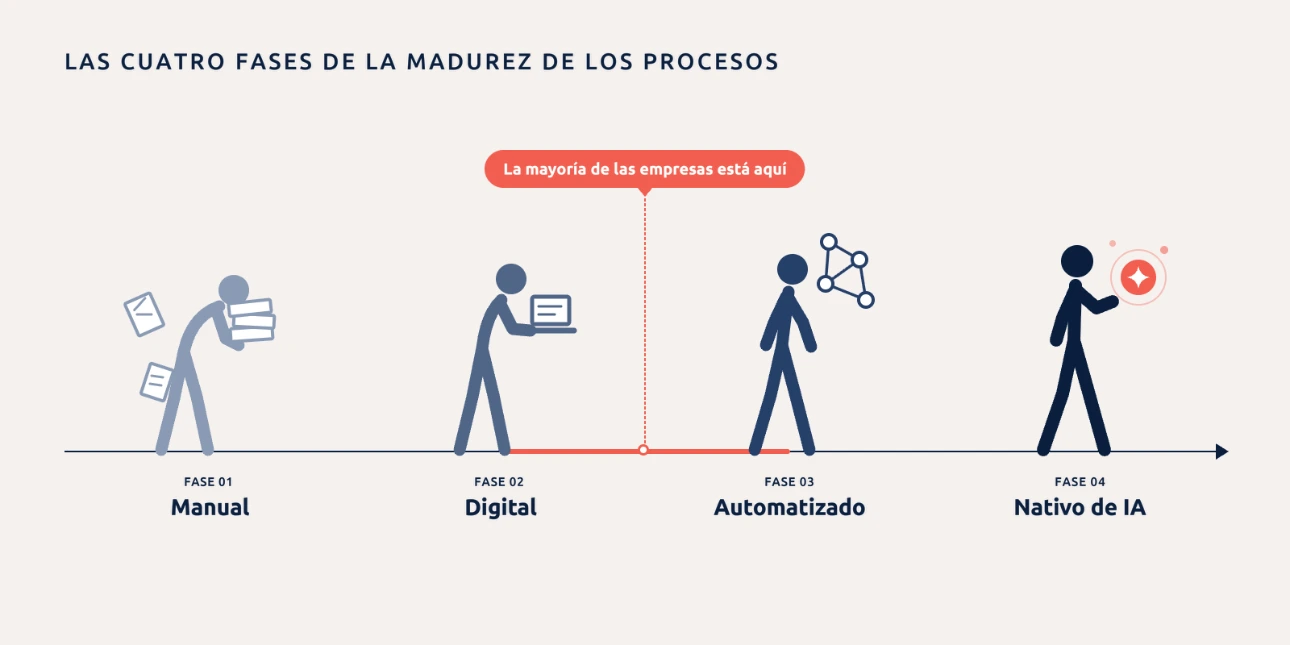
Manual
Information lives on paper, in spreadsheets, emails and notes, and gets copied from one document to the next. Your team spends time searching for documents and re-entering the same data, which leads to errors and lost hours.
Digital
Data and documents are stored digitally and can be accessed from anywhere. Nothing gets lost, but every step still depends on someone entering or moving data by hand.
Automated
An integrated ERP connects sales, purchasing, inventory, accounting and the rest. Data entered once is available to every team that needs it, and automation rules trigger the next steps of a process on their own.
AI-native
AI agents handle tasks themselves instead of waiting for a rule or a person to start them. Standard cases run without anyone touching them, and your team only reviews the exceptions. Over time, AI takes on more complex work and becomes an essential part of your processes.
How we automate your processes with AI
We focus on return on investment. By starting with the processes that pay back fastest, our automation projects often pay for themselves in under 6 months.
1. We map how your processes run today
In a process potential analysis, we work with your core teams to get a clear picture of where time and money go:
Your core processes and the teams that run them
How often each one runs per month, how long it takes and what it costs
The quality of the underlying data and the systems it depends on, which decides how much work automation will take.
2. We find where you lose the most time
With the numbers in place, we look for the tasks that slow your team down:
Processes that are still manual in each department
Data entered twice, tasks waiting on someone else and recurring mistakes
The processes that take up most of your employees' time, which are usually the ones they enjoy least.
3. We choose the right automation and prioritise
For each process, we decide what it needs and what to tackle first:
Rule-based automation for tasks with fixed steps, e.g. payment reminders or dashboard updates
AI for tasks that need interpretation, e.g. reading invoices, forecasting demand or qualifying leads
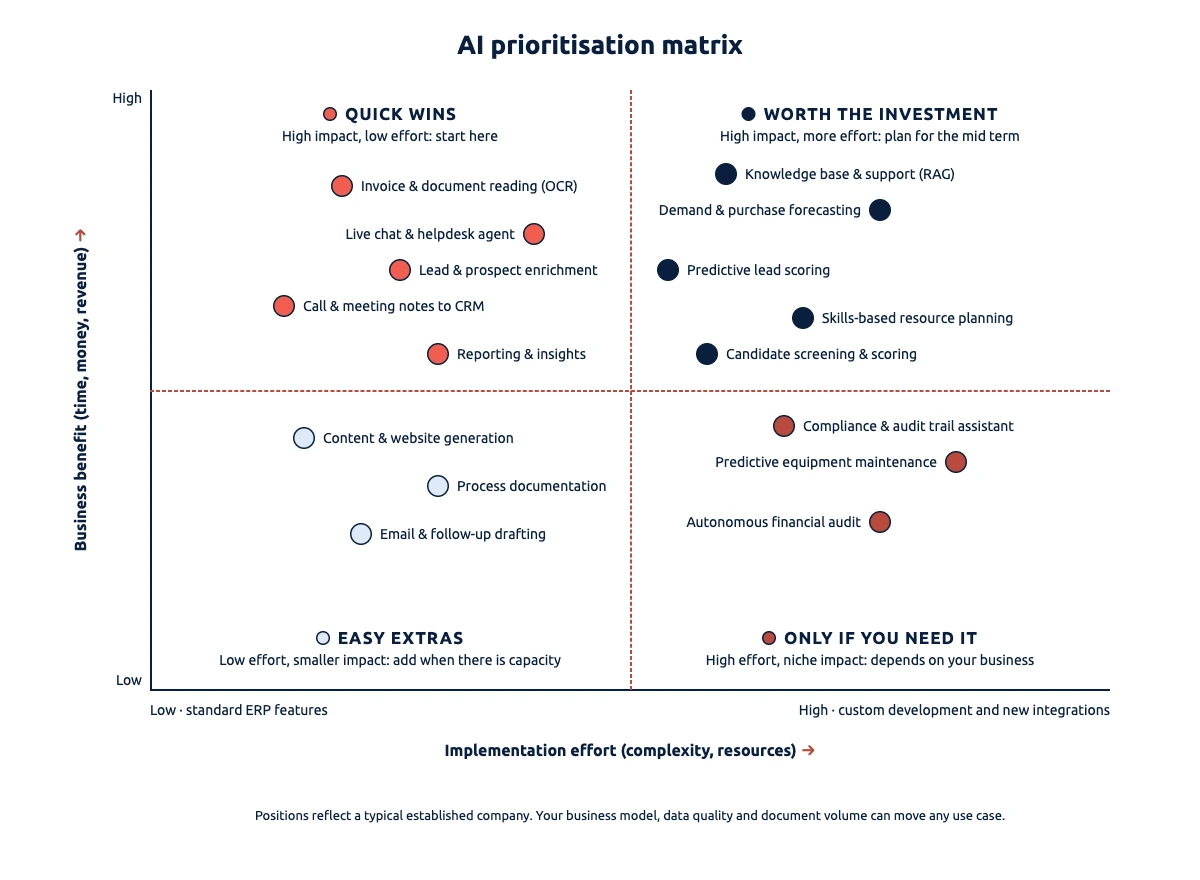
An effort estimate: can standard ERP features cover it, or will it need custom development and new integrations?
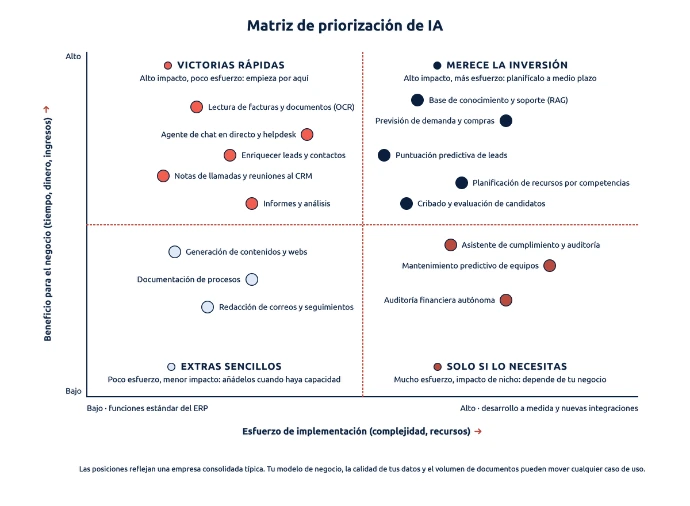
We plot every process on a benefit vs. effort matrix and start with the quick wins. You get a ranked list of your processes with a step-by-step plan for each.
4. We implement and monitor
We start small and build on what already works:
Roll out one process with one team first
Gather feedback in the first weeks, since your team will spot issues quickly
Measure the same numbers as in step 1 to show what you actually save
Adjust where needed, then move on to the next process.
For everyday processes, we don't start from scratch. Our battle-tested templates are already running at some of the fastest-growing companies we work with and usually need only small adjustments.
Processes we can already automate with AI
Accounting & invoices
Supplier invoice comes in → AI reads it and extracts the data → AI matches it with the purchase order and receipt → payment is scheduled automatically based on the payment terms.
Expenses
Employee uploads a receipt → AI reads it and fills in the amount, date, VAT and category → expense is sent to the manager for approval → approved expense is added to the next reimbursement automatically.
Purchasing
AI forecasts demand based on your sales history → stock drops below the forecast level → AI triggers a reorder → purchase order is created and sent to the supplier automatically.
Sales & CRM
New lead comes in → AI qualifies it around the clock → lead is assigned to the right salesperson automatically → AI writes a personalised follow-up.
HR & Recruitment
Application comes in → AI screens it and scores the applicant against the job requirements → shortlisted candidates move to the next stage → interview invitations are sent automatically.
BI & Reporting
Dashboards update in real time automatically → you ask a question about your data → AI answers it and turns your records into a briefing or visualisation.
Customer support
Customer sends a question → ticket is created and routed to the right team automatically → AI answers it based on your company knowledge → complex cases go to your team.
These processes are at the core of most companies. If your use case is very specific, or your industry has its own rules and requirements, you'll need automations built around them, and that takes time and expertise your team may not have.
We build our own AI tools
We develop our own AI tools, including an MCP server, which gives AI assistants direct, secure access to your ERP data.
We use what we implement
We run custom AI agents and build MCP connections in our own work and in customer projects, so we know what works in practice. It also makes us faster: fewer hours on time-and-materials projects and leaner quotes on fixed-price ones.
Our AI experts stay with you
Our dedicated AI and product development experts build your automations. Once they're live, we take care of maintenance and support, so your AI-automated processes keep running smoothly.
Let's find your quick wins
Book a free session with our experts. Tell us how your processes run today, and we'll show you where AI can save you the most time.
We are happy to meet you in person!

Victor Popov
Senior Solutions Consultant

Nuhash Kinzel
Senior Solutions Consultant
You can also message us right here:
We are happy to meet you in person!

Caine Fearn
Managing Director UK

Hamish Ritchie
Senior Solutions Architect

Hailey Edwards
Senior Solutions Architect

Anna Alyakina
Solutions Consultant
You can also message us right here:
AI process automation FAQ
AI needs connected, reliable data to work with, and an integrated ERP is the best source for it. If your data is spread across several disconnected tools, we start by looking at your current setup and what it would take to get your data in shape.
Start with processes that take up a lot of your team's time and need little effort to automate. Typical first candidates are supplier invoices, expenses and lead qualification. A process potential analysis ranks your processes by benefit and effort so you start with the quick wins.
One process with one team can usually go live within weeks, especially when standard templates cover it. Our automation projects often pay for themselves in under 6 months.