Here are all the essential ERP and Odoo news of February you should not miss.
News from Odoo HQ
Official updates and posts from Odoo’s headquarters, Odoo employees, and Odoo founder Fabien Pinckaers.
Odoo to release self-developed IoT hardware
Exciting news from Odoo HQ: a self-developed, dedicated IoT hardware is in the works.
For the first time, Odoo is moving beyond software to create physical devices, designed to integrate with the system - for now, in hospitality.
It’s meant for Odoo users in the industry who have to rely on third-party IoT integrations for fiscal compliance.
They have to acquire external physical devices, like black boxes, to plug into cash registers to legally record tax data. By launching in-house hardware, Odoo is solving a blind spot in its ecosystem.
Odoo is offering its new black box (with an integrated fiscal data module) for free to all Belgian customers, to meet strict compliance and fiscal requirements in its home country.
We’re excited to see if Odoo hardware will expand to more industries and markets.
Odoo hits 12,000 partner milestone
Odoo has officially surpassed 12,000 partners globally.
This comes after a strong start to the year, with Odoo reporting record results in both financial performance and internal growth.
Odoo’s partner network is key to supporting a user base that keeps on growing across the globe.
The European market is home to the largest population of Odoo partners, with 31% of the network.
Still, the Asian and the Middle Eastern markets recently emerged: together, they now account for 36% of Odoo partners worldwide.
The remaining network is spread across Latin America (17%), North America (15%), and Africa (13%).
Odoo and Deloitte expand partnership into France
Deloitte has launched a new specialist team in France dedicated to Odoo.
While Deloitte already works with Odoo in Belgium, this new French division provides local companies with a more reliable way to set up their ERP systems.
France is currently Odoo's second-largest market globally, making the expansion a logical step for both organisations.
Odoo announces XPO Masterclasses 2026
Odoo has officially opened registration for the upcoming Masterclasses, taking place on 22nd and 23rd September. These intensive two-day courses are priced at €990.00 per person, which includes full catering.
What stays the same: As usual, the sessions will be held immediately before the Odoo Experience. Core subjects such as Accounting, Web Framework, Scaling, and Module Development remain a vital part of the curriculum.
What’s new? This year, the programme has expanded to eight tracks instead of seven. While Manufacturing and Dashboards have been removed, three new subjects have joined the line-up: Inventory (including Barcode), eCommerce, and a dedicated class for Studio Experts. Furthermore, the AI track has been broadened to cover all business areas.
If you’re interested, you’ll need to be quick—these expert workshops (especially Accounting) tend to sell out very fast.
→ Register here
Odoo Experience is coming to Latin America
Odoo keeps on growing and this year, it’s bringing their flagship event to the Americas!
Odoo Experience LATAM will be taking place between the 2nd and 3rd of September 2026, just a few weeks before the European original.
With over 10,000 expected attendees, Odoo is positioning this as America's biggest Tech & Business event.
As Odoo gains ground in the American market, hosting this event in Mexico is a strategic move on Odoo’s side: It’s a central point between the northern and southern continents - and home to its LATAM office.
→ Register here 
Odoo kicks off 2026 with record €20M ARR growth month
CEO Fabien Pinckaers announced a record start to the year, with €20 million in new Annual Recurring Revenue booked in January alone.
Typically, Odoo reaches its biggest numbers in December and slows down in Q1.
This strong start hints at an early acceleration and sets a promising pace for the coming year.
Odoo.sh sets mandatory 6-year expiration for all versions
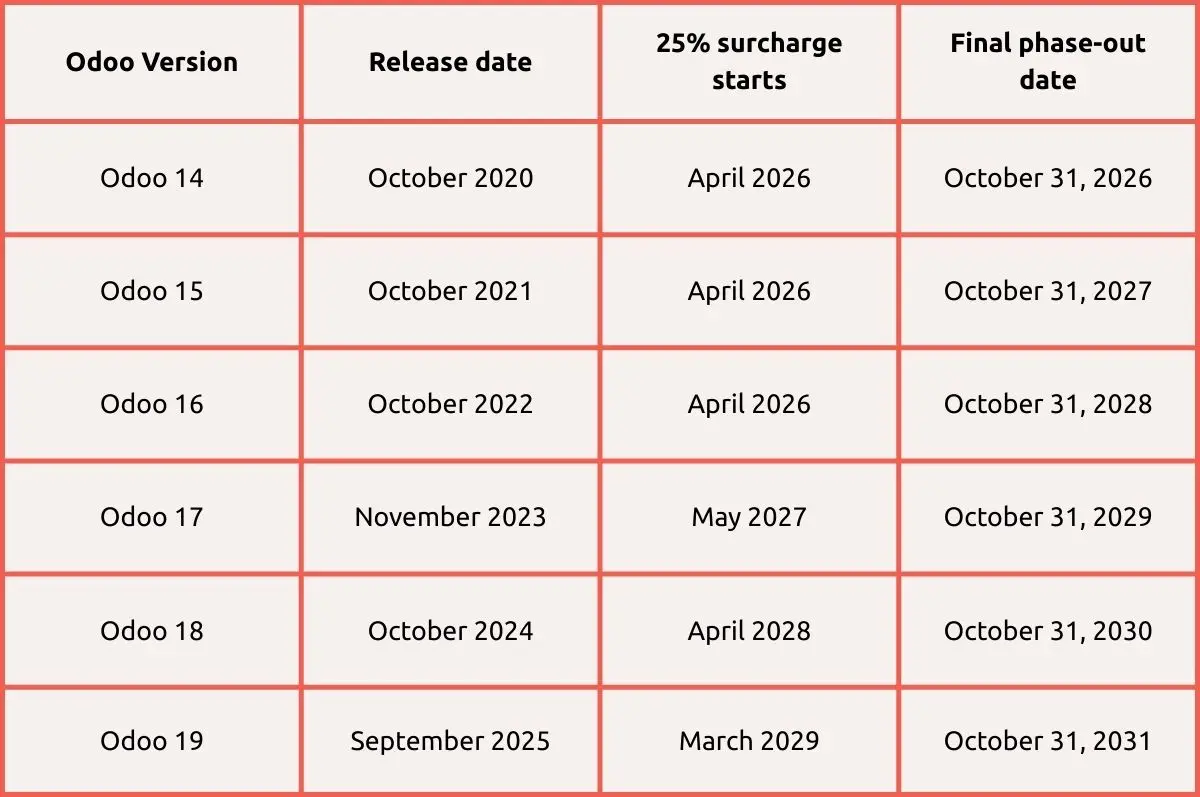
Odoo has officially extended the lifecycle of versions hosted on Odoo.sh. While this offers more flexibility for long-term planning, it introduces a new "Extended Support" surcharge and a hard cutoff date for older databases.
Key takeaways for users:
- Odoo continues to provide free bug fixes and security updates for the three most recent major versions.
- Once a version reaches 3.5 years old, a 25% surcharge is automatically added to your subscription to cover extended maintenance.
- To keep your environment secure, Odoo.sh will now automatically migrate your underlying Ubuntu OS to the latest LTS version, even if you stay on an older Odoo version.
- Every version now has a "kill date." On October 31 of its 6th year, the version is fully phased out. Any database still running on that version will be permanently blocked.
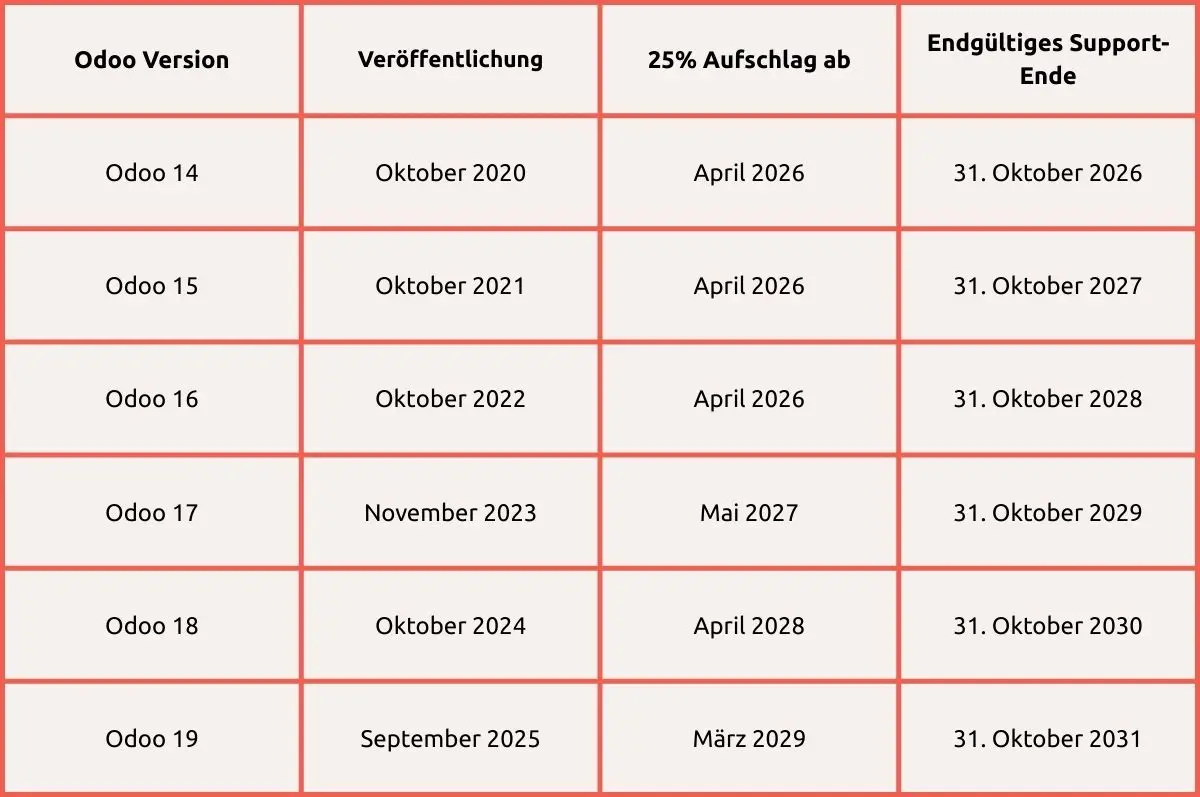
Odoo.sh sets mandatory 6-year expiration for all versions
Odoo has officially extended the lifecycle of versions hosted on Odoo.sh. While this offers more flexibility for long-term planning, it introduces a new "Extended Support" surcharge and a hard cutoff date for older databases.
Key takeaways for users:
- Odoo continues to provide free bug fixes and security updates for the three most recent major versions.
- Once a version reaches 3.5 years old, a 25% surcharge is automatically added to your subscription to cover extended maintenance.
- To keep your environment secure, Odoo.sh will now automatically migrate your underlying Ubuntu OS to the latest LTS version, even if you stay on an older Odoo version.
- Every version now has a "kill date." On October 31 of its 6th year, the version is fully phased out. Any database still running on that version will be permanently blocked.
Odoo and iData form IoT partnership
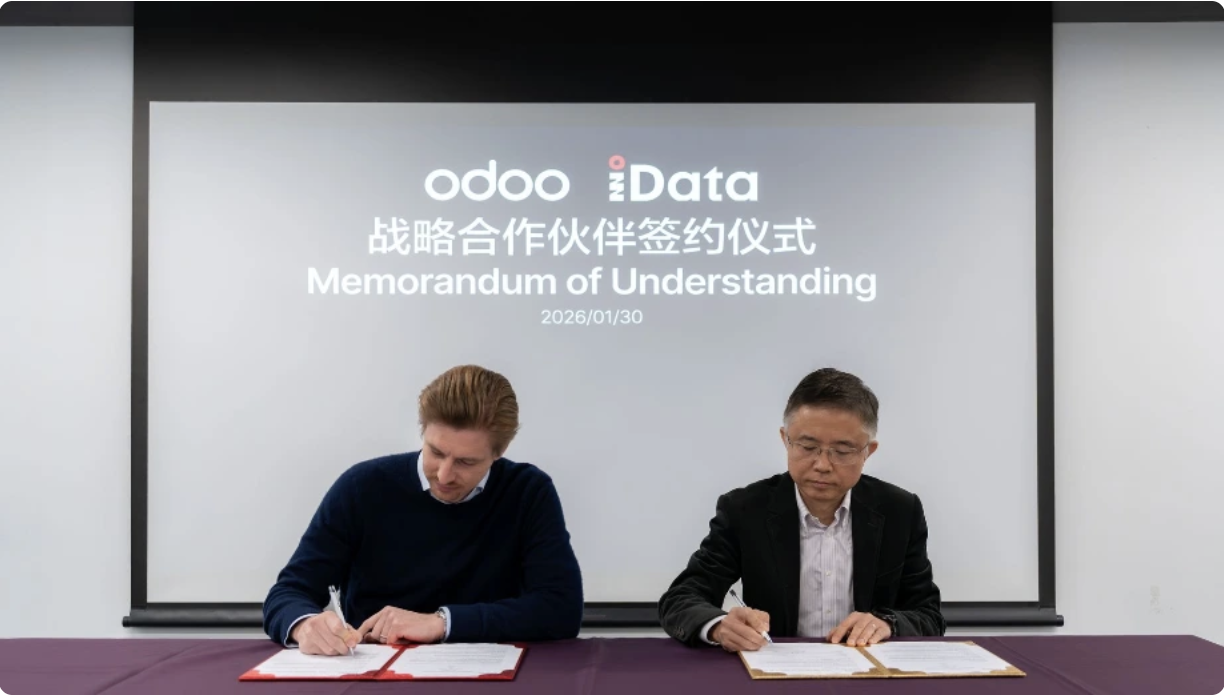
Odoo has partnered with Chinese hardware specialist iData to launch integrated digital solutions for the APAC market.
By pairing Odoo’s software with iData’s industrial PDAs, barcode scanners, and RFID readers, the collaboration provides a complete "software + hardware" package that Odoo previously lacked.
While the hardware is already used globally, this initial rollout targets a critical gap for enterprises in China. It remains to be seen if the partnership will expand to other international markets in the future.
Odoo to open new office in the Philippines
According to internal sources, Odoo will open a new office in the Philippines during the first half of 2026.
Although there’s no official confirmation, we’ve seen speculation that the office could open in Quezon City, which would align with Odoo’s second-city philosophy.
It would also speak for Odoo’s bet on the growing APAC market, with the Philippines working as a central location for Southeast Asia.
Community talk
All the hot topics and discussions Odoo users are buzzing about this month.
Odoo.sh launches native vibe coding via Claude Code
Odoo CEO Fabien Pinckaers has announced that vibe coding is officially being integrated into Odoo.sh.
It’s a move that brings Claude Code directly into the ecosystem, allowing developers to describe features in plain English and ship them to production in minutes.
Because Odoo is open source, AI models have already been extensively trained on its framework. Pinckaers notes that this familiarity allows AI to build and tailor modules with a high degree of accuracy rather than just "guessing" at the logic.
The announcement has sparked a sharp debate among the community.
Many users are excited by the potential for faster prototyping and increased independence for small teams. On the other hand, experienced developers warn that "shipping fast" isn't the same as "building right."
They fear that vibe coding in the wrong hands could lead to a mess of uncontrolled customisations, security vulnerabilities, and broken business rules, much like the issues seen with Odoo Studio in the past.
Ultimately, the consensus is that the developer’s role is shifting toward governance and architecture.
While the AI can now handle the build speed, the human expert is still required to ensure the code handles real-world operational chaos.
Hidden Odoo database bug explained
An Odoo user shared a fix for a hidden 500 error on the database selector page.
The bug was a "permission denied" error, but the user was unable to find it in the production databases. Instead, it was hiding in the maintenance database (marked with "*") that Odoo uses internally.
The table there was owned by root (the system's master account) instead of the Odoo database user. This caused the selector to crash every time it tried to load.
By reassigning ownership and properly granting privileges, the user restored the system to 200 OK.
Key takeaway for Odoo admins: when the selector fails, look beyond your production DBs and check the system-level maintenance database.
ChatGPT or Gemini?
A recent blog post by Odoo has sparked quite a debate on LinkedIn, offering a head-to-head comparison between the heavyweights: ChatGPT and Google Gemini.
While ChatGPT is widely praised for its creative flair and the ability to build bespoke workflows (Custom GPTs), Gemini wins points for its seamless integration into the Google Workspace ecosystem. For the Odoo community, the most exciting takeaway is that both models can be linked directly to Odoo to automate ERP processes through AI-driven analytics.
However, the feedback from the community has been mixed:
- A call for variety: Many users are asking for European solutions like Mistral, or the model Claude, to reduce reliance on US tech giants.
- Support concerns: One commenter warned that despite the efficiency of AI, Odoo must not overlook human support. AI simply cannot replace expert consultancy during complex implementations.
- Performance vs. Consistency: While users admire the power of Gemini Ultra, ChatGPT is often preferred for its superior "memory" during long conversations.
News from the ERP world
Headlines from the ERP world you shouldn’t miss.
Microsoft patches Copilot bug after data leak
Microsoft has patched a security flaw that allowed its AI assistant, Copilot, to access and summarise confidential emails without permission.
The error affected enterprise users, surfacing data from draft and sent folders in Outlook, even when sensitivity labels and data loss prevention (DLP) policies were active.
While Microsoft claims the bug did not grant access to unauthorised users, the tool effectively bypassed internal protections designed to exclude protected content from AI processing. This creates a significant trust gap, as Copilot ignored the very guardrails companies rely on for compliance.
Reports suggest Microsoft became aware of the flaw in January, yet the patch was only recently released. This delay highlights a growing risk in the AI arms race, where the pressure to ship features often outpaces corporate governance.
Microsoft and SAP issue critical security alerts
On 10th February 2026, both Microsoft and SAP released urgent security warnings. IT teams were given just 48 hours to react as attackers began exploiting active vulnerabilities.
Microsoft is patching 59 vulnerabilities, including six "zero-day" exploits. Hackers have been bypasssing Windows warning systems or taking full control of servers via Remote Desktop connections.
SAP has addressed 26 new vulnerabilities, two of which are classified as "HotNews" (the highest priority). Most critical is a flaw in CRM and S/4HANA (scoring 9.9 out of 10), which allows attackers to inject malicious code and gain full access to sensitive financial and customer data.
Installing patches for S/4HANA and Windows systems is now a top priority for all businesses.
Workday invests billions in Canada
Cloud ERP provider Workday has announced plans to invest approximately one billion Canadian dollars in Canada over the next five years. The capital will be used to significantly expand its footprint in Artificial Intelligence, local software development, and customer support.
The focus is on modernising HR and finance processes through AI-powered, "human-centric" systems. With over 500 existing customers, Canada remains one of the most important markets for the US-based corporation.
OpenAI’s new "Frontier" seeks to bridge (or disrupt?) enterprise software
OpenAI has launched Frontier, an enterprise platform designed to create and manage autonomous AI agents.
Positioned as an "intelligence layer", the platform is built to sit on top of existing cloud infrastructures like SAP, Salesforce, and Oracle, allowing AI agents to pull data directly from these systems to automate complex workflows in finance, HR, and supply chain management.
While OpenAI frames the move as a partnership to enhance existing software, the new platform represents a significant challenge to the traditional SaaS model.
By allowing companies to build bespoke "fleets of agents" directly through OpenAI, Frontier could bypass the expensive, rigid modules offered by legacy providers and even OpenAI’s partner, Microsoft.
As digital work shifts toward autonomous execution, the success of Frontier will depend on whether these software giants adapt to the new layer or see their core business logic cannibalized by OpenAI’s agents.