Here are all the essential ERP and Odoo news of March you should not miss.
News from Odoo HQ
Official updates and posts from Odoo’s headquarters, Odoo employees, and Odoo founder Fabien Pinckaers.
Odoo teases 19.3 sneak peek in new webinar series
Odoo 19.2 was just revealed, but we might get a look at Odoo 19.3. sooner than we think.
Odoo recently launched a new webinar series led by internal consultants that dives deep into features from the Odoo 19 minor releases.
Most of these videos cover the highlights of Odoo 19.1 and 19.2. However, some upcoming webinars scheduled for a month from now already promise sneak peeks at Odoo 19.3.

With each minor release, we get closer to unveiling what Odoo 20 will look like. And soon, you’ll see which new features we might get in Point of Sale (Retail).
But based on insider info, we expect to see more of these exclusive webinars in the coming months!
Currently released webinars have already covered:
- The discontinuation of Field Service and its integration with the Planning app
- Manufacturing highlights for 19.1 and 19.2.
Odoo 19.2 release notes are here
Odoo has officially released version 19.2. This update focuses heavily on industry-specific features and optimising core app interactions. It also adds several UI improvements and powerful AI additions.
Some highlights worth knowing about:
General
- Use "Share" from the command palette, or ALT + SHIFT + H, to copy a link to your current view that preserves all applied searches, filters, and groupings
- Define starting and ending buffers in the Gantt view to visualise setup or cooldown times for scheduled tasks
- When the connection is lost, menus and records that are not cached are now muted, making it clear what is inaccessible while offline.
AI & automation
- Add specific context and dynamic values to default AI prompts for more tailored answers
- Automatically assign the most appropriate emission factors to sustainability data in the ESG app.
Field Service merged into Planning
- Field Service has been discontinued as a standalone app; all its features are now fully integrated into the Planning app.
Accounting
- Payment statuses have been renamed for clarity: "In Process" is now "Paid," and "Paid" is now "Reconciled"
- The payment wizard now automatically detects and deducts pending payments from the amount due to prevent double payments
- Exchange gains and losses are now consolidated into a single line per invoice, which can be expanded to view the full calculation details.
Manufacturing
- A new Work Order Kanban view allows you to visualise and adapt production planning with a simple drag-and-drop interface
- Flexible consumption is now the default for all manufacturing orders, regardless of whether it was specifically selected on the Bill of Materials.
Documents & Sign
- Update the underlying document of a Sign template without recreating it; Odoo will automatically preserve your existing signature fields in their original positions
- Support has been added for non-Latin alphabets, including Cyrillic, Devanagari, and Arabic, covering over 40 new countries.
Spreadsheet
- Lock entire sheets within a workbook to prevent accidental modifications
- New Regex formulas (REGEXTEST and REGEXPLACE) have been added for advanced data manipulation.
Industries
- New industry packages are available for Mental Therapy and Physical Therapy, including patient management, session notes, and specialised billing
- The Construction Developer industry now includes work items for more scalable quotations and site remark management.
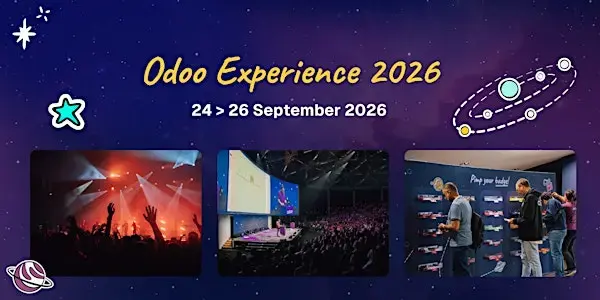
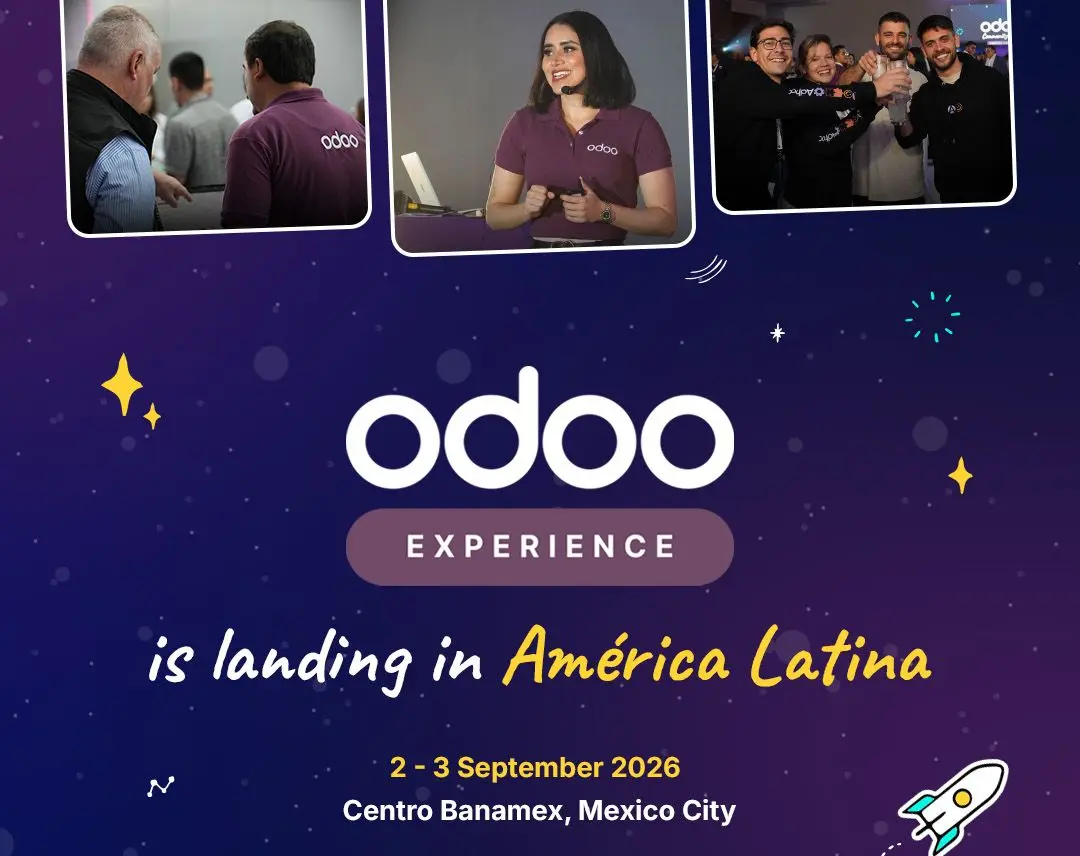
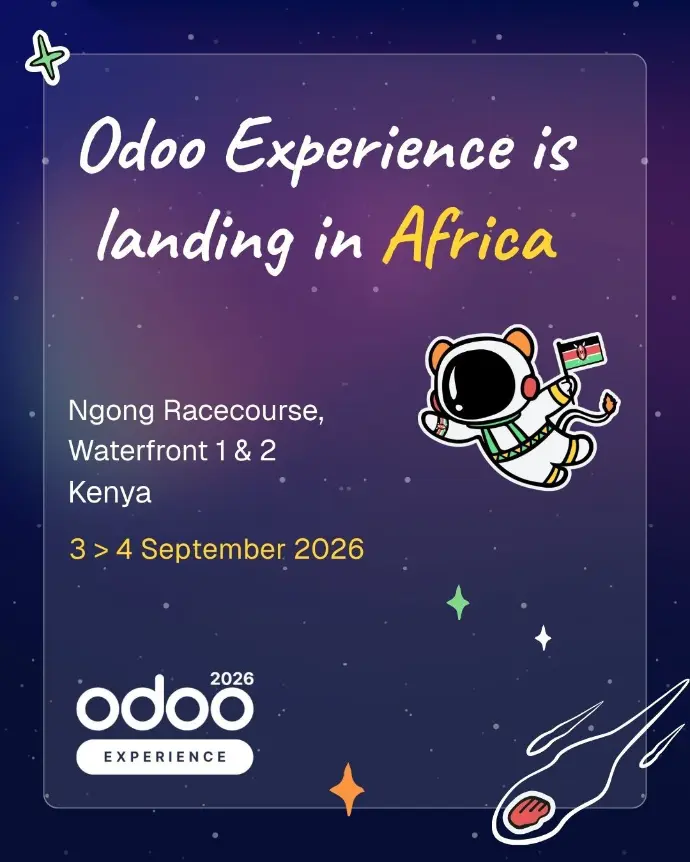
Odoo Experience 2026 is going global
Odoo’s flagship event is expanding into a global series for 2026.
Own versions of Odoo Experience were recently announced for San Francisco (September 2-3), Mexico City (September 2-3), and Nairobi (September 3-4).
This rebranding of regional Odoo Community Days into official OXP events suggests a major shift in Odoo’s international strategy and growth.
But the new OXPs have created some confusion around the Odoo 20 reveal.
The European event will take place from September 24-26, and it has been the official stage for unveiling new Odoo versions for the past few years.
However, webpages for all OXP 2026 editions now claim that Odoo 20 will be released "during the event".
With the Americas and Africa shows happening weeks earlier, we’re left wondering: who will be the first to see the official Odoo 20 reveal?
More info about Odoo Experience 2026 events:

Odoo teases new AI feature for image generation
Odoo is doubling down on its “AI everywhere” strategy with a new feature to speed up online sales.
CEO Fabien Pinckaers took to LinkedIn to show users how to generate and enhance product images directly within the Odoo chatbot.
Instead of using external design software, shop owners can soon prompt AI to create visuals from scratch or polish existing photos.
This adds a creative layer to Odoo’s website and online sales AI tools, which previously focused mainly on text and SEO.
The new feature is expected to be released with Odoo 19.2.
Community talk
All the hot topics and discussions Odoo users are buzzing about this month.
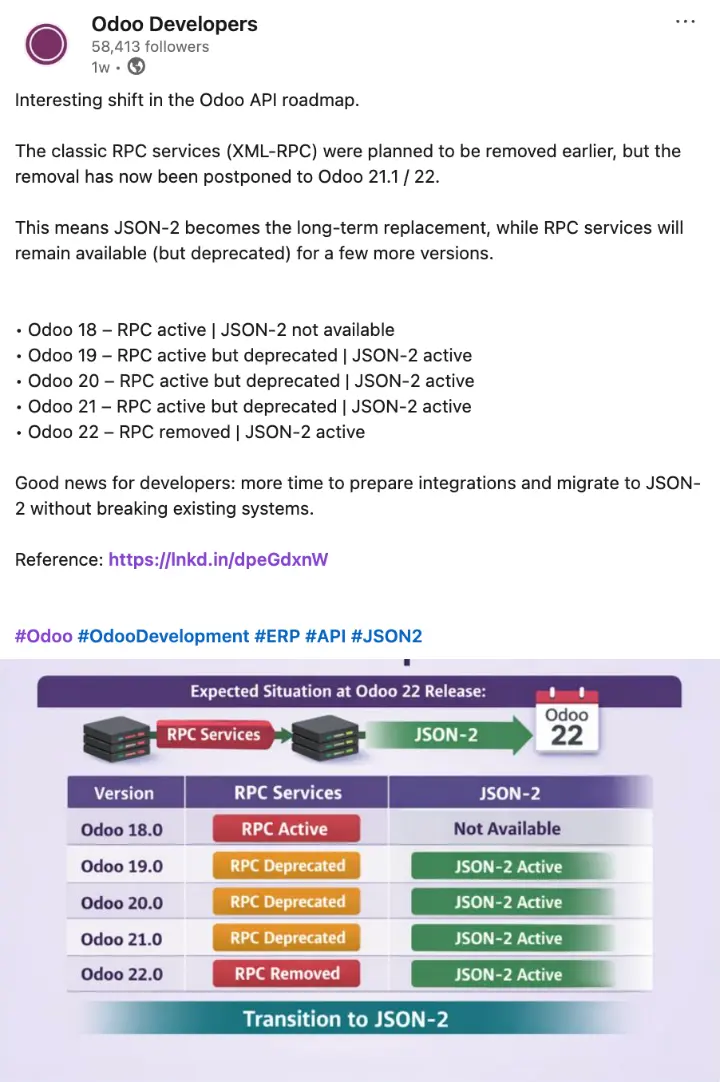
Odoo shifts API roadmap and delays removing RPC to version 22
The dev community confirmed that Odoo is delaying the removal of classic RPC API services (XML-RPC) to version 22.
The original plan had scheduled the deprecation of RPC API for Odoo 19 and the hard removal for Odoo 20.
But official GitHub documentation showed a recent shift in the Odoo API roadmap.
Under the updated roadmap, Odoo has postponed the final deletion of RPC to version 22, keeping the legacy service live for two additional years:
- Odoo 18: XML-RPC remains the active standard; JSON-2 is not yet available
- Odoo 19, 20, 21: JSON-2 becomes the active replacement, while XML-RPC remains available but officially deprecated and in legacy mode
- Odoo 22: Odoo removes XML-RPC entirely; all external integrations must use JSON-2.
This change follows internal discussions where Odoo's technical team successfully lobbied to delay the cutoff. Lead developer Julien Castiaux noted that an earlier removal was "convinced to be a bad idea" due to the impact on existing integrations. This results in a more manageable multi-year transition plan.
Experts in the Odoo community welcome the extra time, noting it provides the necessary window to migrate complex client systems without breaking live environments.
However, some developers also pointed out that Odoo’s annual release format already demands significant maintenance, and this delay only shifts that inevitable workload.
One thing is agreed upon: with the discontinuation of old API models and the recent introduction of vibe-coding, an Odoo developer’s role is moving toward system architecture and proactive refactoring.
While the old protocol remains available for now, the community recommendation is to begin adopting JSON-2 early to ensure stability before the Odoo 22 deadline.
Mixed reactions for the new Odoo mobile interface
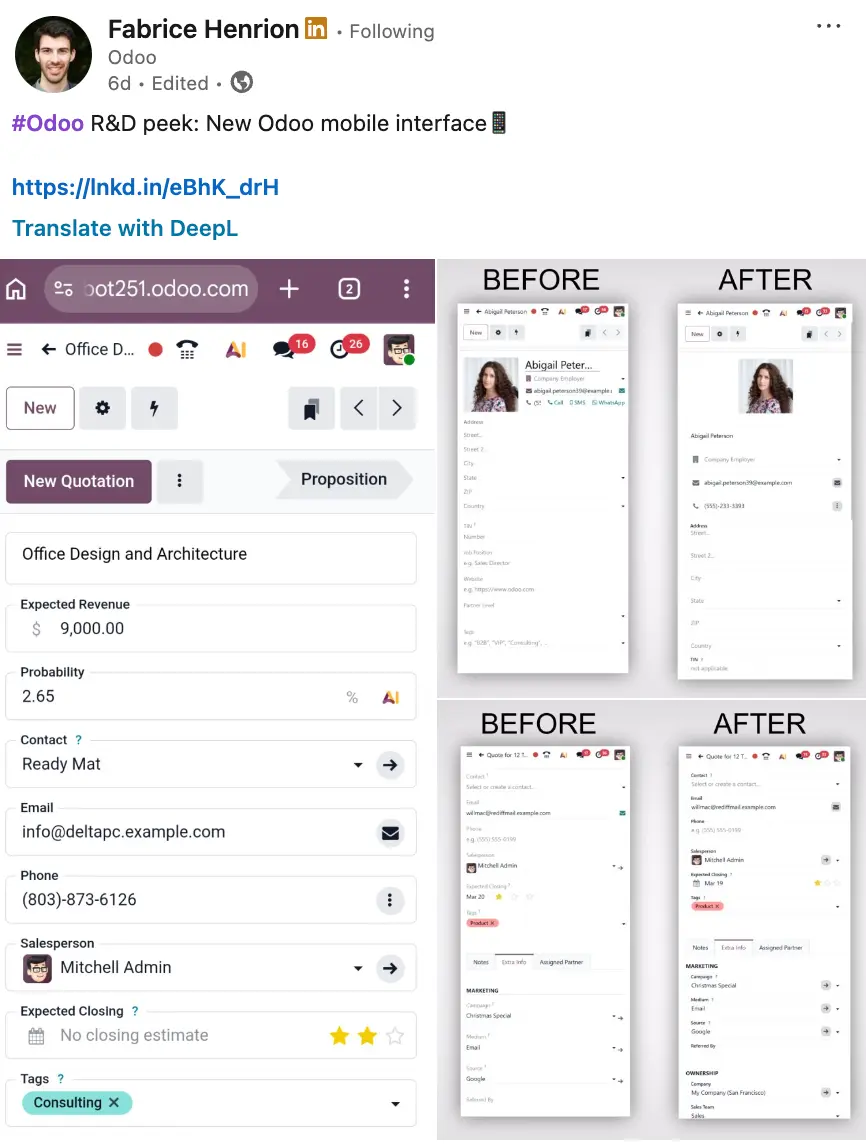
Odooer Fabrice Henrion shared an R&D sneak peek on LinkedIn, revealing a redesigned mobile interface.
Odoo’s mobile interface and usability have been some of its most widely criticised features, both in the downloadable and progressive web app (PWA).
Users responded to the redesign enthusiastically, highlighting improvements like “ved space in between fields”, “fitting more in the screen”, and “visible/contrasted field labels”.
But while for some, Odoo “is going in a good direction” with improving its mobile features, others say that the UI is still outdated.
In the end, form follows function - we hope that Odoo 20 brings improvements to both the look & feel and responsiveness of its mobile features.
Big divide over Claude Code & Odoo vibe coding
Heated debates have sparked on LinkedIn over the reality of vibe coding within the Odoo ecosystem, less than a week after it was announced.
The Odoo community is torn, as on one side, advocates argue that AI-generated code is more stable than Odoo Studio.
One side claims Claude Code can outperform many human developers in complex areas like accounting logic. They see a shift toward "AI builders”: professionals who focus on business architecture rather than writing syntax.
On the other hand, sceptics point to the dangers of using Odoo Studio without training as a cautionary tale.
They warn that vibe coding in production without strict guardrails could lead to broken business rules and unmaintainable systems.
The debate even reached Odoo HQ. Chief Product Owner Alain van de Werve noted that success relies heavily on peer reviews, provided the reviewer "has the time" to keep up with the AI's speed.
Similarly, Odoo developer William André emphasised that while the environment is secure, it doesn't replace the need for manual testing.
Still, there is a consensus: the developer's role is shifting from author to analyst.
While AI can now handle 100% of the build speed, human experts are still required to check that the vibes align with live operations.
News from the ERP world
Headlines from the ERP world you shouldn’t miss.
Oracle joins the AI agent race with autonomous business teams
It feels like every major software provider has already launched their own AI agents, and now Oracle is officially joining the club.
Following in the footsteps of rivals like Salesforce, Microsoft, and SAP, Oracle is rolling out autonomous AI agents across its Fusion Cloud Applications.
Instead of just giving you a basic chatbot that answers questions, these new agents are designed to take a specific business goal and independently figure out how to get it done.
At launch, Oracle is introducing 22 of these applications covering HR, finance, sales, and procurement. The clever part is that they don't work alone; they act as coordinated teams with specific roles. They can break down tasks, pull in external information like weather forecasts or LinkedIn profiles, and automatically handle complex jobs like chasing up unpaid invoices or finding new suppliers.
For developers wanting to build their own, Oracle is also expanding its AI Agent Studio with tools to create custom agents that actually remember past interactions.
Letting AI run your business processes sounds like a security headache, but Oracle insists it's safe. The agents strictly inherit all existing user permissions and approval rules, so every action leaves a clear paper trail.
However, the pressure is on for this launch. Oracle is currently facing a shareholder class-action lawsuit over its massive AI infrastructure spending. Investors are growing impatient, questioning whether these heavy financial bets will actually pay off.
With this new release, Oracle has to prove that its AI can deliver real-world profits, rather than just adding to the industry hype.
Claude can now autonomously control your computer
Anthropic has launched a Computer Use feature that controls your computer and autonomously performs tasks.
It allows Claude to mimic human keyboard and mouse inputs. This means the AI can independently search through or use local applications like web browsers and developer tools to complete complex requests.
The tool also integrates with Dispatch, allowing users to assign tasks to Claude via mobile, such as running morning briefings or codebase tests.
This move is a direct response to the viral success of OpenClaw, the open-source framework that popularised autonomous "claws" earlier this year.
Currently, the feature is limited to macOS and available only to users on the Claude Pro and Claude Max subscription tiers.
To minimise hacks, Claude requires explicit permission before taking control and uses automated scans to block prompt injections. However, the company labelled the feature a "research preview" and warned users not to use it on apps that contain sensitive personal or financial data.
Claude’s Computer Use feature is speeding up the race for agentic dominance as Anthropic joins Nvidia and OpenAI in providing infrastructure for independent AI agents.
Still, while Anthropic uses permission blockers to mitigate risks, it’s hard to take this as a safety guarantee. AI still hallucinates often, and models move faster than the guardrails designed to stop them.
For now, giving AI the steering wheel of a computer might still be a high-stakes security gamble.
Nvidia launches enterprise-secure AI agent platform NemoClaw
Nvidia has launched NemoClaw, an enterprise-grade platform designed to solve the main security and privacy hurdles of AI agents.
The platform is built on OpenClaw, a popular open-source framework for running AI agents locally. NemoClaw adds a layer of hardened security and privacy features that allow enterprises to deploy agentic systems with a single command.
Nvidia collaborated directly with OpenClaw creator Peter Steinberger to ensure the platform remains accessible while meeting corporate standards.
The platform is hardware-agnostic, meaning organisations don’t have to run on Nvidia’s GPUs to use it. It allows users to build agents using any open-source model or access cloud-based models on local devices.
CEO Jensen Huang compared the need for an "OpenClaw strategy" to historical tech milestones like Linux, HTTP, and Kubernetes. He framed agentic systems as the next mandatory infrastructure for global enterprises.
While still in an early alpha release, NemoClaw is being pitted against rivals like OpenAI’s Frontier in the race to provide the governance layers critical for AI adoption.
OpenAI releases smaller & cheaper GPT-5.4 models
Following an expansion of its latest AI architecture, OpenAI has released new GPT-5.4 Mini and GPT-5.4 Nano models.
These budget offerings are designed as a midpoint between high-end intelligence and real-world speed.
Performance benchmarks show that the Mini model scored 88.01% on the GPQA Diamond reasoning test, closely trailing the standard model’s 93%.
On top of that, GPT-5.4 Mini version reportedly runs over twice as fast as the original GPT-5 Mini.
Up until now, agentic capabilities were previously restricted to the more expensive GPT Standard versions. But with GPT-5.4, smaller models can reliably navigate complex tool-calling and subagent tasks like reviewing codebases or interpreting dense user interfaces.
Even more, these smaller models are closing in on the accuracy of the GPT-5.4 Standard model.
Early adopters like Notion and Hebbia report that GPT-5.4 Mini matched or exceeded larger predecessors on specific output tasks and citation recall, all while utilising significantly less compute.
This means that in many professional AI use cases, smaller is now synonymous with smarter, considering the price-to-performance ratio.
Pricing updates for the GPT-5.4 models:
- GPT-5.4 Mini: $0.75 per million input tokens and $4.50 per million output tokens (roughly 70% cheaper than the standard model)
- GPT-5.4 Nano: $0.20 per million input tokens and $1.25 per million output tokens (API-only)
- GPT-5.4 Standard: $2.50 per million input tokens and $15.00 per million output tokens.
AI agent hacks McKinsey’s internal chatbot in under two hours
Cybersecurity researchers at CodeWall revealed that one of their autonomous AI agents successfully hacked "Lilli," McKinsey’s internal generative AI platform.
They gained full read-write access in under two hours without any human input or stolen credentials
The AI agent exposed 46.5 million chat messages, 728,000 confidential files, and the system prompts that control the AI’s behaviour for the 40,000 employees who use it.
The hack was achieved via a SQL injection flaw found in an unauthenticated API endpoint.
Because the agent gained write access, it could have corrupted the AI by silently rewriting its instructions, changing how the chatbot cited sources or followed security guardrails.
While McKinsey patched the holes within hours of CodeWall sharing the report, the incident serves as chilling proof that agentic AI will power the future of cyberattacks.
The vulnerability highlights a growing risk in the enterprise world: as companies rush to embed AI assistants into their core operations, they are creating massive new attack surfaces.
This "AI vs. AI" showdown proves that machine-speed security breaches aren’t just a theory anymore, but a real danger for even the largest corporate infrastructures.
Oracle shares bounce back amid AI overinvestment fears
Oracle shares rose by 10% after a promising revenue forecast. This calmed investors who worried over the company’s massive $50B AI spending in December.
With a recent staggering 325% jump in future contracted revenue (RPO) to $553 billion, Oracle is successfully positioning itself as the main AI infrastructure landlord for giants like OpenAI and Meta.
These results eased "SaaS-pocalypse" fears, i.e. the concern that AI coding tools will eventually devalue traditional per-seat software licensing.
CTO Larry Ellison also claimed that Oracle is already using small, AI-assisted engineering teams to build new products faster and more efficiently than ever before.
Still, while AI infrastructure is booming for Oracle, analysts remain watchful.
Only time will tell whether infrastructure earnings can counterbalance a shrinking user base as AI takes over traditional tasks in ERP.
SAP pays $480M to settle Teradata lawsuit
SAP has agreed to a $480 million out-of-court settlement with the data warehouse specialist Teradata, ending an eight-year legal battle over intellectual property theft and market abuse.
The deal resolves all outstanding claims, just weeks before a high-stakes trial was set to begin in April.
The dispute centred on allegations that SAP used a 2006 joint venture to steal trade secrets to develop its flagship HANA database.
Teradata further accused SAP of violating antitrust laws by bundling HANA with S/4HANA to unfairly block database competitors from the ERP market.
The decision to settle follows a major setback at the US Supreme Court, which recently denied SAP’s motion to dismiss the antitrust claims.
By opting for a massive payout, SAP clears a significant legal cloud that has loomed over its database technology and market strategy since 2018.
SAP reorganises exec board to address AI disruption fears
SAP CEO Christian Klein has announced a major executive shake-up to pivot the company toward an AI-first strategy.
The move follows a difficult year for SAP: its stock price plummeted 39%, causing it to lose its title as Europe’s most valuable public company.
To focus entirely on AI development, Klein is handing off his sales oversight to Thomas Saueressig, who will become Chief Customer Officer on April 1.
Saueressig will lead the newly formed Customer Value Group, a unit designed to merge sales and customer relations into a single vertical.
Klein also noted that SAP must "transform end to end" to keep pace with the evolution of agentic AI.
The reorganisation was most likely set to address scepticism of SAP’s internal AI assistant, Joule. While SAP claims "strong interest," some users have reported that the tool is difficult to use and doesn't yet justify its cost.
SAP launches new support model to push for cloud adoption
SAP has launched a new three-tiered support structure (Foundational, Advanced, and Max) exclusive to cloud subscriptions.
While the tiers offer a simplified model for cloud users, the primary focus is on delivering AI-powered support and process optimisation.
By making these “Success Plans" cloud-only, SAP is effectively leaving on-premises customers on legacy maintenance contracts with no access to the latest AI innovations and support.
This reinforces SAP’s aggressive strategy: if you want access to their AI-powered future, you have to move to the cloud.
Analysts warn that while the new tiers offer more transparency, they also introduce higher costs and reduced contractual flexibility, particularly in the premium Max tier.
For on-premises teams, the message is clear: the support gap between legacy and cloud will only widen from now on.
Germany reopens ERP start-up loans for non-profits
Following the German parliament’s approval of the 2026 ERP Economic Planning Act, the state-owned KfW bank has resumed its "StartGeld" (Program 067) scheme for non-profit organisations.
While previously restricted, eligibility has now been permanently broadened. For the first time, the programme is available to all German enterprises focused on the public good, including non-profits and social startups, alongside traditional commercial small businesses.
Key benefits of the updated programme:
- Increased funding: The maximum loan limit has recently been raised from €125,000 to €200,000.
- Flexible use: Funds cover both initial investments and working capital (up to €80,000).
- Lower barriers: No personal equity is required, and the KfW assumes 80% of the default risk to encourage private house banks to approve the credit.
- Repayment holidays: Borrowers can benefit from up to two years of interest-only payments to protect liquidity during the critical launch phase.
Let’s talk Odoo
Reach out to our Odoo experts to see everything Odoo can do and how to tailor it to your business.