Here are all the essential ERP and Odoo news of October that you should not miss.
News from Odoo HQ
Official updates and posts from Odoo’s headquarters, Odoo employees, and Odoo founder Fabien Pinckaers.
Odoo reaches €10 billion valuation
Odoo is now valued at €10 billion, up from €7 billion one year ago. Revenues are expected to reach €900 million this year, with the €1 billion mark in sight for 2027.
Here’s where Odoo stands today:
28 million users
21 worldwide offices
180+ countries with Odoo customers.
Despite the growth, CEO Fabien Pinckaers has made it clear that Odoo is not for sale. This means that the product roadmap stays in Odoo’s own hands without giving in to external pressure.
With AI at the top of the product agenda, the pace set by v20 won’t slow down anytime soon.
Strategically, the company is focusing on greater international expansion and internal growth. Odoo’s 7,500-strong team is expected to reach 10,000 employees by 2027.
Highlights from the Odoo Experience 2026
After a month of regional events across the globe, Odoo Experience made its final stop at Brussels Expo from 24 to 26 September.
It was Odoo’s 20th anniversary, and CEO Fabien Pinckaers marked the occasion by unveiling version 20 across two separate keynotes.
Last month’s sneak peeks pointed to an AI-native Odoo, and the final release delivered on that promise, along with a few other long-awaited updates:
AI Skills: reusable skills, knowledge sources and automation triggers for AI agents
Native MCP server: external AI assistants like Claude or ChatGPT can connect directly to Odoo
Light User mode: limited access for employees who only need HR self-service, POS or field work at a lower price
Improved offline mode: create and edit records without a connection, with automatic sync
Multi-company improvements: company-specific lead times, product categories and intercompany resupply routes
Bill line prediction: product, account, tax and analytics pre-filled from history
Suggested reordering rules: min/max stock levels proposed from demand history
Continuous production: next operations start as soon as quantities are ready
Marketing Automation workflow builder: drag-and-drop campaigns with event-based triggers
AI call transcripts: recorded Discuss calls with automatic summaries
AI website assistant: generate pages from your products, events or other websites
Mobile app redesign: touch-optimised forms, bottom-sheet pickers, swipe down for the command palette, and a new login screen
File sharing from phone to Odoo: send files straight in to create bills, expenses, tasks, leads or time off requests.
The much. team was there for all three days, sharing 1,200+ cups of coffee with the Odoosphere from our big red booth.
Our experts also delivered 17 talks on AI, manufacturing, eCommerce, subscriptions and more. If you missed them live, you can catch up below:
Zero-Click Gmail Integration for Odoo CRM: Fully Automated Email Logging
Warranty Repairs Done Right: Managing Vendor Repairs with Odoo Helpdesk & Repairs
Odoo for Aerospace: Enforcing No-Fly Zones in the Warehouse
Building Heat Treatment Plants in Odoo: Automating ETO Manufacturing with 20,000 BoMs
How to build a project agreement framework in Odoo for complex wholesale distribution
Stop Writing AI Prompts by Hand: Building a Self-Fixing Native AI Loop in Odoo 19
Automating the Impossible: Heuristic MRP Scheduling for Mid-Sized Companies inside the Odoo Core
Escaping the Inventory Freeze: Just-in-Time Procurement in Odoo Enterprise
Stop Answering the Same Tickets: Building a Self-Teaching Helpdesk with AI in Odoo 19
How to handle 250,000 Dropshipping Products in Odoo
The Two Hats of Odoo Python: Powering Core Logic vs. Driving User Experience
Building High-Performance Odoo eCommerce with S3 and Google Merchant Center
Killing the 8 Wastes: A Functional Blueprint for Lean Manufacturing in Odoo Enterprise
Consolidating the Stack: Replacing WooCommerce with Native Odoo Enterprise eCommerce Extensions
Unified Commerce with Odoo Enterprise: E-Commerce, PoS & Marketplace - All in One
Beyond Serial Numbers: Automating High-Volume Software Licensing in Odoo Enterprise
Community talk
All the hot topics and discussions Odoo users are buzzing about this month.
The new Odoo 20 AI credit model leaves users guessing
AI was the highlight of the Odoo 20 launch. But Odoo's new payment model for AI via IAP (in-app purchases) is now sparking a debate.
Every AI feature in Odoo 20 runs on IAP credits, bought on top of user licences. On paper, one credit costs €1. What’s unclear is what the credit is actually worth: a million tokens, one chat, or one summarised email.
The Odoosphere took to LinkedIn, Reddit and Odoo Community forums to get answers. Product owners at Odoo who build the feature couldn’t give a clear reply on how credits are calculated, leaving users unable to estimate their future AI costs.
CEO Fabien Pinckaers stepped in to clear doubts, claiming that Odoo had an "issue with credit consumption" and "fixed it the day before". He stated that Odoo is also looking at using cheaper AI models for simpler requests, though he admitted it’s "still not optimum".
Still, the community isn’t convinced. Partners claimed that they can’t explain AI costs to clients when they can’t estimate them themselves. Users looking ahead at v20 are holding off on upgrading until Odoo has fixed the early issues.
On top of pricing uncertainty, AI users in Odoo brought up a bigger worry: in Odoo 19, you could connect your own ChatGPT or Gemini account. In Odoo 20, every AI request goes through Odoo’s own service, and Odoo chooses the model.
For Odoo users that need predictable AI costs and flexibility today, their best bet is to connect AI models to Odoo through an MCP server.
Mixed reactions to Odoo's new Light User mode and pricing
Odoo introduced new pricing from 24 September 2026, alongside the launch of v20.
According to Odoo, it’s the first European price change in four years, which follows 26% inflation since 2022 and rising costs.
Here's what's changing:
One-App free plan: no changes
Standard Plan: no changes
Custom Plan: 20% increase for new users
Light users: a new reduced-price user type, from €7.90 per month depending on the country.
Existing users on the Custom Plan will see a maximum increase of 7% per year at renewal, in line with Odoo's subscription agreement. To get the Light User price, customers need to be on Odoo 20 and sign a new Enterprise agreement.
The newly introduced Light Users get access to a limited set of apps:
As users: their own Time Off, Expenses, Appraisals, Attendances, Referrals, Planning + Field Service, Inventory Barcode Operator, and read-only Knowledge
As employees: Payslips, Point of Sale, Shop Floor, and all other apps a user has access to.
But there’s a detail that’s currently sparking a debate: any active employee record in the HR app that isn't linked to a full user account also counts as a light user. Several Odoo experts took to LinkedIn to share their reactions, and the response was very mixed.
Most users were surprised that a simple employee record, with no login and no direct use of the system, now comes with a licence fee. For businesses with large workforces that only use HR or payroll, that adds up quickly.
CEO Fabien Pinckaers responded in the comments, defending that employee records do mean usage, from payslips to POS and shop floor access. He stated that businesses can avoid the extra cost by deactivating inactive employees or not registering each one individually.
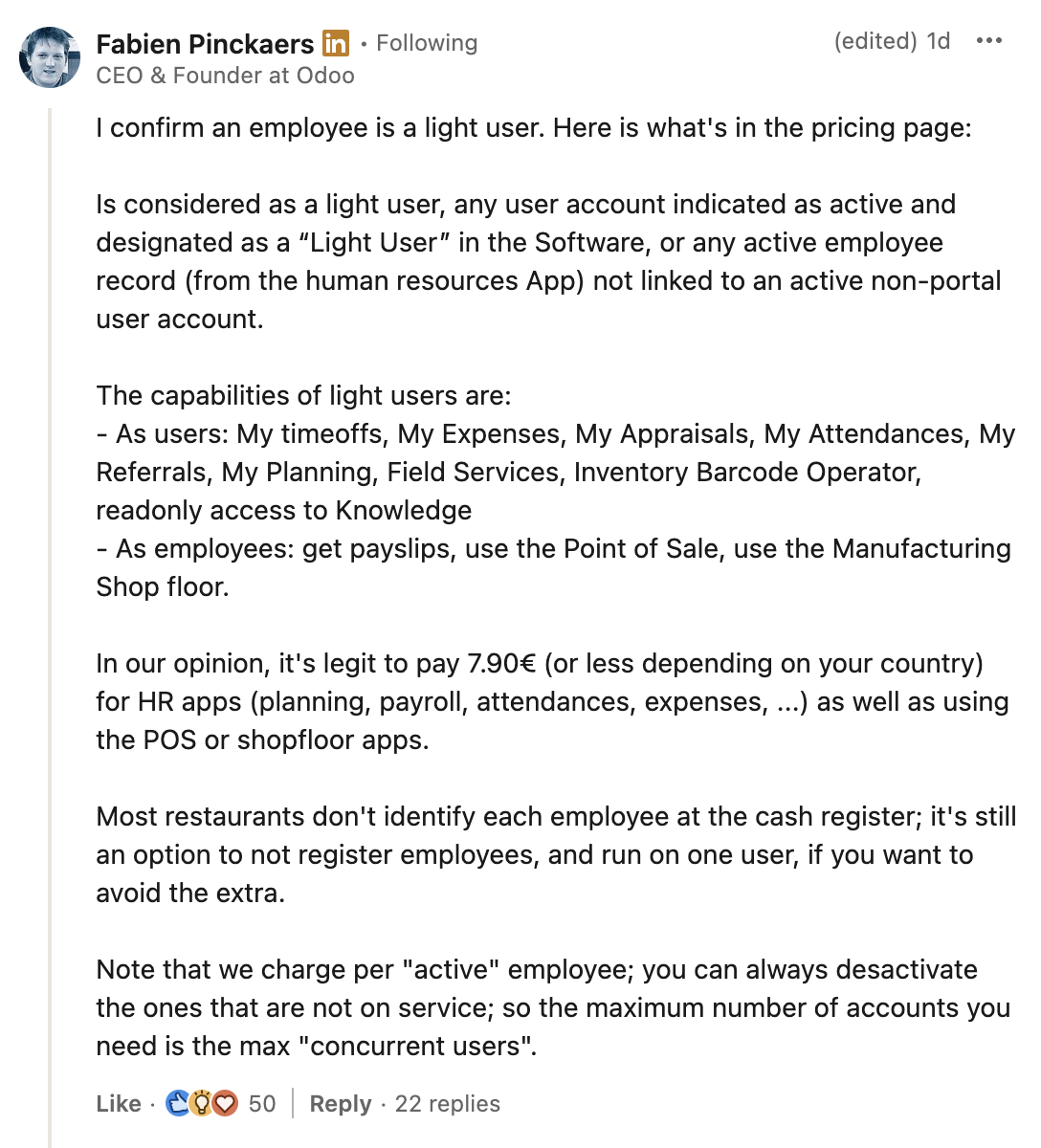
Still, the community isn’t convinced yet. Many say they'll need to see how the Light User model plays out in real business cases before deciding whether it's a fair trade-off.
If you're planning on upgrading to Odoo 20, now's a good time to review how many active employee records you have and what the new pricing could mean for your subscription.
News from the ERP world
Headlines from the ERP world you shouldn’t miss.
SAP buys Belgian AI start-up TechWolf for HR data mapping
SAP will acquire TechWolf, a Belgium-based company that uses AI to map jobs and skills, and the deal is expected to close by the end of the year.
TechWolf combines HR and business data with labour market data to show which roles each employee performs and which skills they have. SAP plans to use it to strengthen SuccessFactors, its talent management software.
According to SAP, TechWolf will remain an independently-led entity. The platform is already used by companies like HSBC, GSK and PayPal, and it should stay available to businesses running software from other vendors.
This acquisition adds to SAP's record of buying new capabilities and adding them to its stack as separate products. Odoo takes the opposite approach: skills tracking is built into the HR suite and shares one database with the rest of the business, without adding another vendor.
Let’s talk Odoo
Reach out to our Odoo experts to see everything Odoo can do and how to tailor it to your business.