Here are all the essential ERP and Odoo news of January you should not miss.
News from Odoo HQ
Official updates and posts from Odoo’s headquarters, Odoo employees, and Odoo founder Fabien Pinckaers.
Odoo reports remarkable growth results for 2025
Odoo has released some global results for 2025, showing continued strong expansion across revenue, recurring income, and workforce.
Figures from an official company presentation shared online claim:
- $712M in revenue (+23% YoY)
- $554M in annual recurring revenue (+46% YoY)
- 7,089 employees worldwide (+47% YoY)
The latest numbers build on a multi-year growth trajectory that has seen Odoo steadily increase both scale and scope.
In recent years, the company has moved beyond its traditional SME focus, investing in more mature, industry-ready product offerings across areas such as payroll, hospitality, compliance, and point of sale.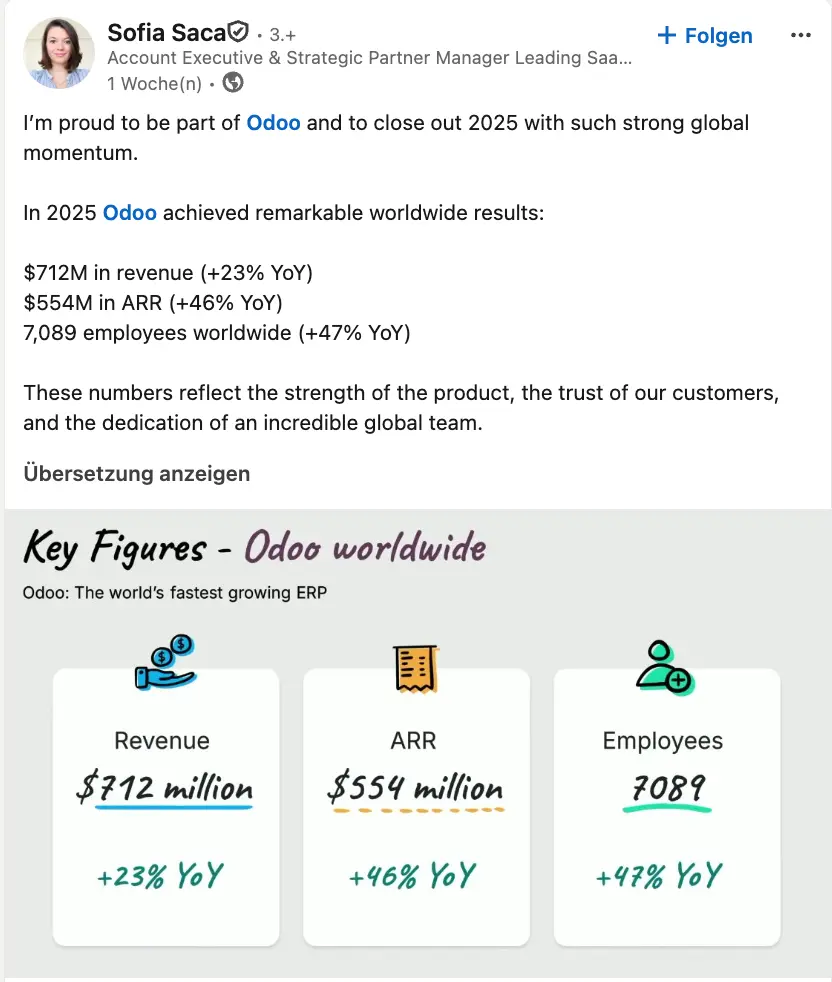
Odoo reaches €7 billion valuation as investor increases stake
Odoo has reached an estimated €7 billion valuation after growth investor General Atlantic increased its stake by acquiring shares from Wallonie Entreprendre. The deal is a secondary transaction, meaning no new capital was raised and Odoo remains privately held.
Since first investing in 2023, General Atlantic has backed Odoo’s international expansion and commercial growth. The move underlines long-term confidence in Odoo’s strategy and reflects a broader trend of European software companies scaling globally while staying independent.
Odoo 19.1 release notes are here
Odoo has officially released version 19.1. As is usual for minor releases, this update does not bring any new apps or major functionalities. Instead, it brings many small improvements aimed at refining existing workflows.
Highlights worth knowing about:
General
- Product variants can be imported in bulk, including attributes, costs, quantities and more
AI
- AI agents can now build views by grouping data by day, month, quarter or year - no need to set this up manually via advanced search anymore
- You can ask questions about the content of a document directly while previewing it (e.g. a CV or contract)
- AI agents now support file uploads and allow questions based on the uploaded content
Accounting
- When sales totals are converted between currencies, the exchange rate date is shown on hover
Manufacturing
- When planning multiple manufacturing orders with scheduled dates, Odoo now ignores the dates and plans them ASAP based on the list order
- If the quantity of an ongoing manufacturing order is reduced, the order can be split: the original MO is updated, and a new MO is automatically created for the remaining quantity
Inventory
- In the replenishment dashboard, the “Order” and “Order to Max” buttons have been merged: By default, Odoo uses the value from the “To Order” column when creating a PO; if this value is adjusted manually, the updated quantity is used.
Timesheets
- ActivityWatch is now integrated: Device activity is automatically tracked and listed in the timesheet assistant, where activities can be assigned to a project and converted into timesheet entries with one click
Helpdesk
- A new filter allows you to quickly identify unanswered tickets where the last message came from the customer
- Send customers a reminder email before their ticket is automatically closed.
Sales / Quotations
- Quotation templates now support subsections and options such as “Hide Price” and “Hide Composition”
And many more!
Odoo CEO denies rumours about price increases
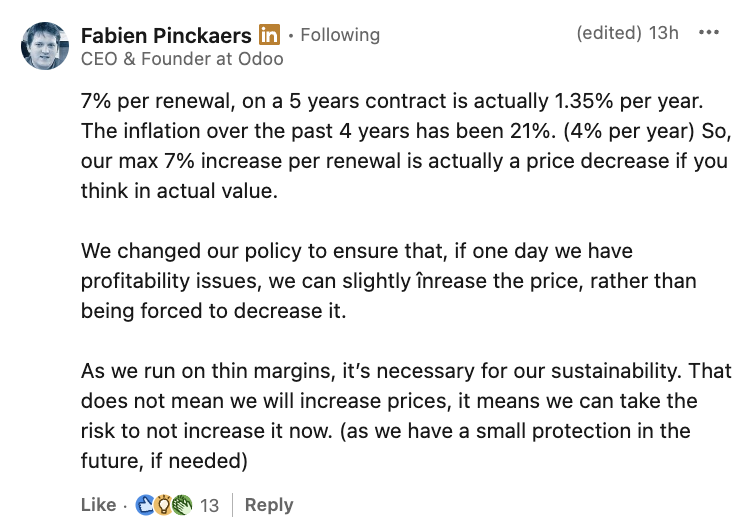
Odoo CEO Fabien Pinckaers has pushed back against claims that the company is planning to raise its software license prices.
The concerns began after Odoo updated its terms and conditions to allow annual renewal fees to increase by up to 7 per cent. The change worried some European partners and customers, especially after a recent 30 per cent price increase in the United States.
Pinckaers said the update was meant to give the company more flexibility in the future and support long-term stability. He added that it was intended to help avoid a price increase in the near term.
Odoo introduces new GBP price list
Good news for UK customers: Odoo has officially introduced a dedicated GBP price list!
Internal sources shared that new customers will be placed on GBP pricing by default, while existing customers are expected to move over at renewal. Upsells will stay on the current price list for now.
The announced GBP pricing is £22 for Standard Odoo, and £33.60 for Custom Odoo.
Previously, Odoo users in the UK had to convert their license prices from EUR values. Introducing a GBP price list shows that the UK market is growing - and Odoo is adapting to keep up!
Community talk
All the hot topics and discussions Odoo users are buzzing about this month.
Pros and cons of Odoo Studio
A recent LinkedIn post reopened the long-running debate around Odoo Studio.
The user positioned Studio as a fast-to-market tool for building and adapting Odoo applications with minimal code. Immediate pushback in the comment section was to be expected.
Because yes, Studio offers speed and accessibility. It works well for quick UI changes, simple workflows, and early-stage prototypes, allowing teams to move fast without heavy development effort.
Still, extensive use of Studio carries many risks and is not advisable.
Complex logic built through Studio can impact performance, complicate upgrades, and create long-term technical debt. As projects grow, maintainability and scalability become harder to manage.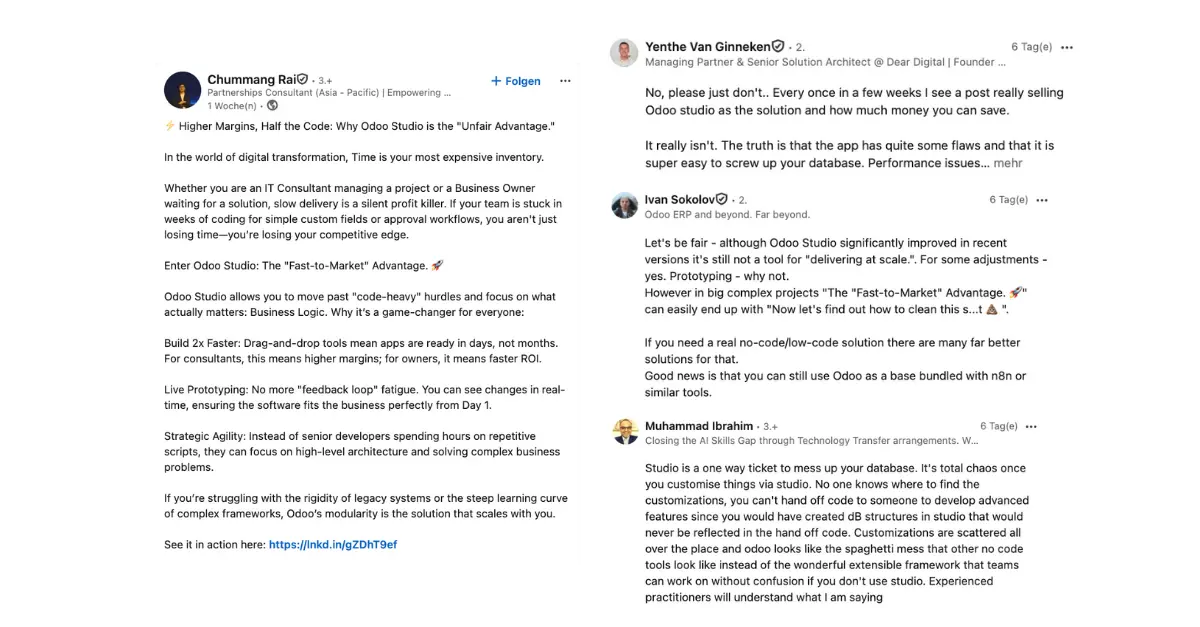
Odoo forum experiences temporary downtime
A LinkedIn post by Odoo partner Jakub Vera sparked a discussion after users in several regions were unable to access the official Odoo forum for over a week, encountering 403 errors or restricted access.
Beyond the technical issue itself, the situation led to questions around communication and expectations, as the forum is a widely used source of documentation, best practices, and implementation knowledge.
Community members highlighted the forum’s importance:
- a key reference during implementations
- heavily linked via Google and Odoo documentation
- complementary to live support for complex topics
Some users suggested the access restrictions may have been related to spam, botnet attacks or aggressive crawlers. Others shared past experiences with similar issues after upgrades.
Access to the forum was later restored, bringing the discussion to a close, but also reminding many how central community platforms remain within the ecosystem.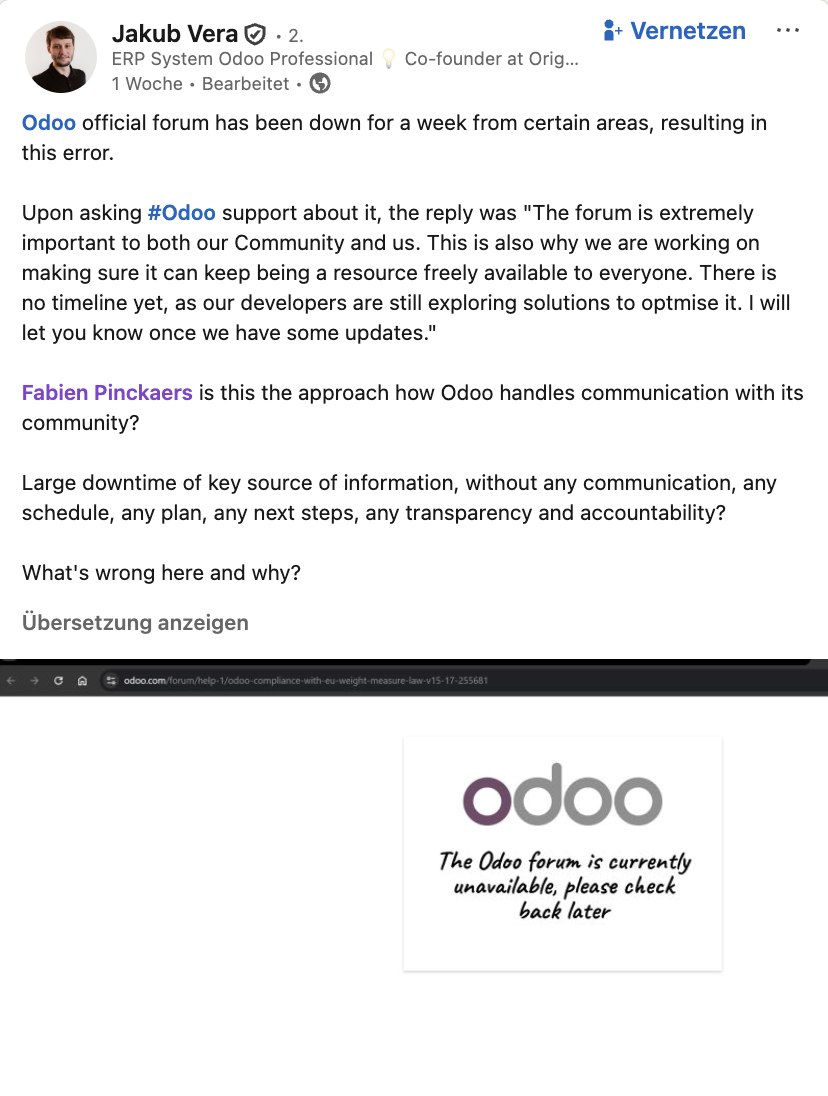
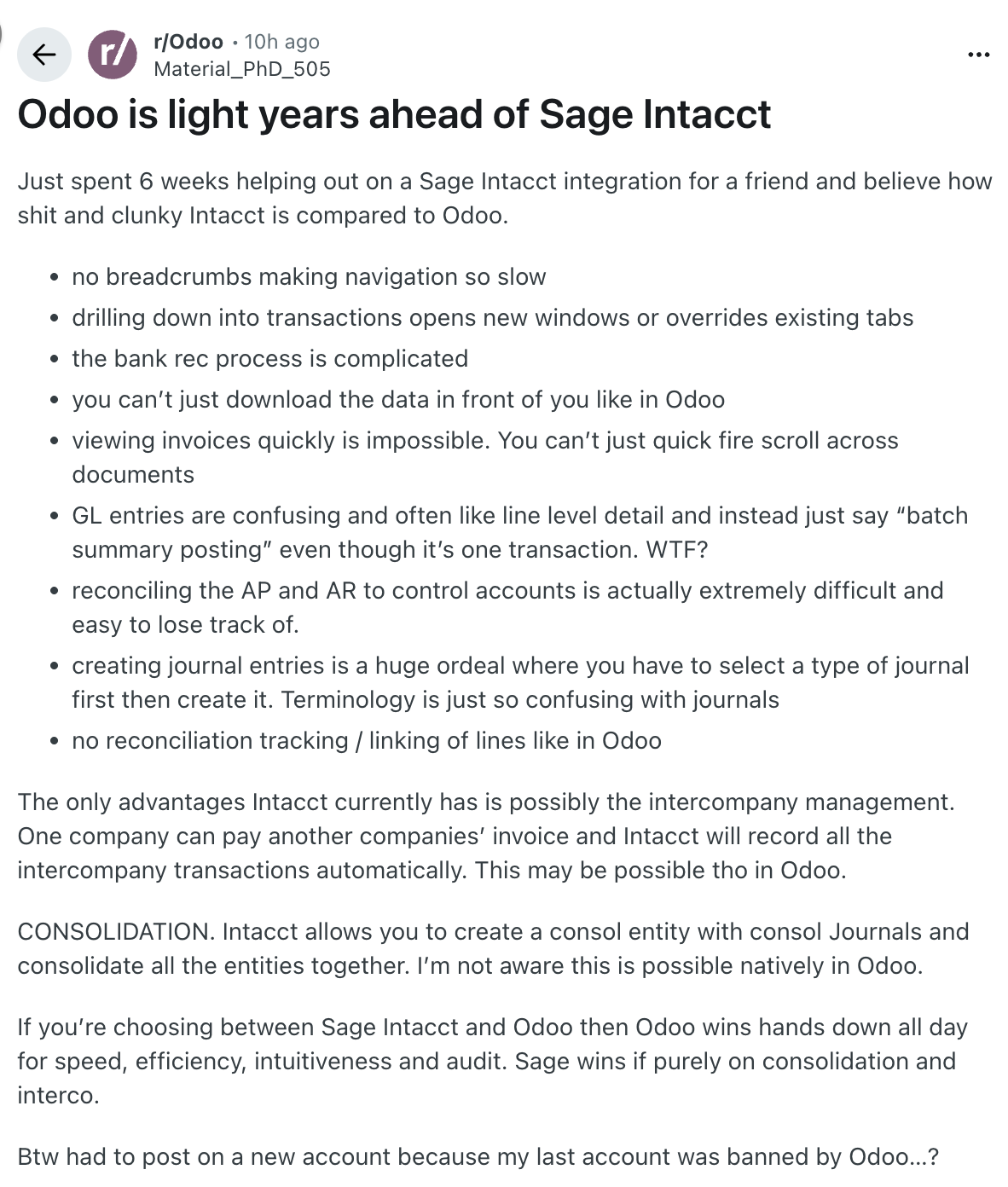
Redditors discuss Odoo Accounting vs Sage Intacct
A Reddit user compared Odoo and Sage Intacct for accounting, highlighting how Odoo stands out when pitted against Intacct:
- Speed and navigation (breadcrumbs)
- Efficiency (journals, reconciliation tracking)
- Intuitiveness (quick invoice views)
- Audit capabilities (downloadable data, consistent terminology)
Intacct leads in multicompany management, though Odoo is rapidly improving in this area. Some users worry about migrating from Sage to Odoo, but even the sceptics acknowledge Odoo’s advantages in features like batch processing.
Odoo’s consolidation features were also noted. While some shortcomings exist, users say configurations can adapt workflows, and “there are some improvements still coming to make the reporting even better”.
As far as Odoo community spaces go, Reddit is often the most scathing - which makes this overview all the more valuable.
See our own Odoo vs Sage comparison
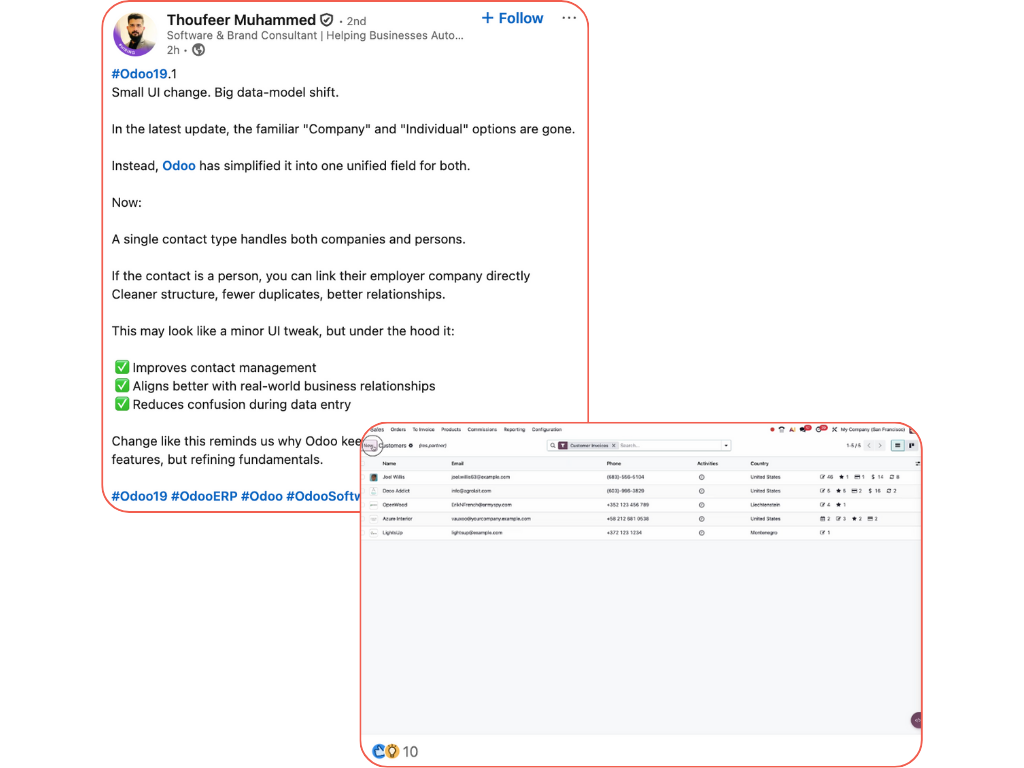
Odoo 19.1 reveals a unified field for contact filtering
Odoo 19.1 is rolling out new UI updates, and people are noticing!
One of the best changes in this minor release is a single field for filtering contacts as either a 'Company' or an 'Individual.' Now, when creating an individual record, you can link them to their employer on the spot.
This cuts out unnecessary clicks and maintains data integrity by ensuring every contact is instantly connected to the relevant business.
Odoo updates Enterprise agreement with 7% annual price indexation
Odoo has quietly adjusted its official Enterprise Terms and Conditions.
According to the updated clause 5.2, renewal fees can now climb by up to 7% for every year of the previous term.
This replaces the old way of doing things, where indexation only happened occasionally at renewal, and ensures prices move toward current list rates much faster.
The shift comes right on the heels of a 30% price jump in the US this January, suggesting a bigger strategy is at play.
Our experts predict that the European market is next on the list for 2026 or 2027, with prices in EU-West potentially hitting €44.90 per month.
While Odoo might bundle in some AI credits to sweeten the deal, the move toward steady annual hikes marks a much tighter pricing strategy that could shake up the market in the short term.
News from the ERP world
Headlines from the ERP world you shouldn’t miss.
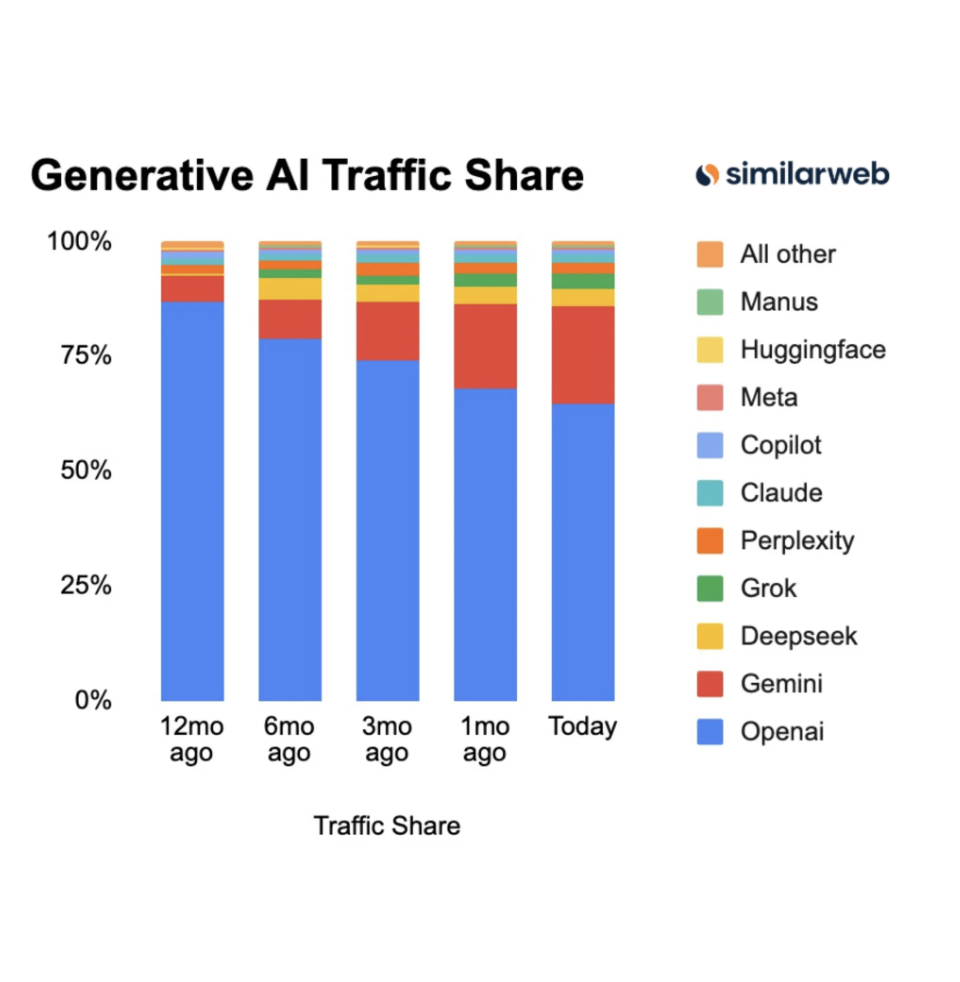
ChatGPT loses traffic share to Gemini
ChatGPT’s lead in the AI traffic market is shrinking as Google’s Gemini continues to grow.
New data from Similarweb shows ChatGPT’s global traffic share at 64.6%, down from 86.6% a year ago.
Gemini’s share rose to 22%, up from 5.3% over the same period.
For the ERP market, this shift might become a strategic turning point. As vendors embed AI assistants into core search and automation workflows, Google’s massive distribution network is positioning Gemini as the new default for enterprise integrations.
The rise of the integrated ecosystem
It seems users are moving away from scattered tools in favor of unified, secure infrastructure.
- Deep integration: With Gemini powering Android and joining Apple Intelligence in 2026, it is becoming the "always-on" AI layer for both personal and professional use.
- Data Governance: For businesses, Gemini allows AI to live within a single governed cloud environment.
- Technical edge: Gemini’s massive context window enables the analysis of entire internal databases. Standalone tools like OpenAI still face technical hurdles.
Dynamics 365 tightens license control: unlicensed users lose access
Microsoft is ending the “honor system” in Dynamics 365 Finance, Supply Chain, and Commerce. From now on, every user must have an explicitly assigned license via the Microsoft 365 Admin Center, or access will be blocked after 15 days. Previously, users could access applications without formal license assignment.
The change adds extra administrative work, forcing IT teams to audit users, align roles with actual needs, and keep licenses up to date.
Sage introduces Copilot in Sage Operations
Sage has rolled out the AI assistant Copilot into Sage Operations, its ERP solution for small and mid-sized manufacturing and distribution companies. The feature is available in early access for customers in Germany.
Sage’s assistant is embedded directly in the ERP interface and provides context-aware insights, warnings, and answers based on live data from orders, inventory, procurement, and deliveries.
This move continues the trend we’ve recently seen from Microsoft, SAP, and other business software providers, as AI assistants quickly become a standard feature in modern ERP systems.
Who succeeds in leveraging AI best in their software remains to be seen.
Oracle sued by bondholders over AI buildout
Oracle is facing a class-action lawsuit for allegedly misleading investors about the capital required for its massive AI infrastructure expansion.
A New York filing claims the tech giant failed to disclose the need for additional funding when it issued $18 billion in bonds in September 2025. Just seven weeks later, Oracle took out a further $38 billion in loans to fund data centers for a major OpenAI contract.
The legal challenge highlights a "swift and severe" market reaction, as the sudden surge in debt increased credit risk and caused bond prices to plummet.
The lawsuit underscores a growing tension in the tech sector: the massive capital expenditure (CapEx) required to win the AI arms race versus the transparency expected by institutional investors.
For Oracle, the challenge in 2026 will be defending its financial disclosures while managing a $300 billion, five-year commitment to OpenAI.
Europe is behind on AI security
European companies are notably behind in AI security, despite pioneering policies like the EU AI Act.
A 2026 Kiteworks report indicates a significant lag in AI anomaly detection compared to the global average of 40%.
Major European economies, including the UK (37%), Germany (35%), and France (32%), all fall short.
The report warns that legislation without operational security is ineffective. It provides a framework that isn’t put into practice, and leaves European firms unequipped to detect compromised data or deal with cyberattacks.
Europe’s challenge for 2026 is to close the gap between policy and execution.
To be both AI-ready and fully secure, organisations must transition from manual governance to automated security controls like real-time monitoring and training-data recovery.
Epicor plans to discontinue on-prem ERP products
ERP vendor Epicor has announced plans to phase out on-premise versions of its products, like Kinetic, Prophet 21, and BisTrack, as part of its shift to a cloud-first strategy.
Final on-prem releases will arrive between 2026 and 2028, followed by tiered active and sustaining support through 2029–2030, depending on the product.
Epicor says the move will give customers faster access to new features and AI-driven capabilities available only in Epicor Cloud, while reducing infrastructure and upgrade burdens.
With all future innovation happening on the cloud, on-prem systems become a maintenance path rather than a growth one, increasing dependency on vendors and reducing customer control.
Still, highly regulated industries that depend on on-prem will not be exempt from this decision. Instead, they may need to find hybrid, private, or sovereign cloud architectures to meet compliance requirements.
Epicor’s decision to sunset on-prem products reflects a broader ERP trend toward cloud consolidation. Vendors seem to be concentrating innovation and AI investment on a single delivery model - time will tell if being cloud-exclusive works for every industry use case.
ERP trends to watch out for in 2026
ERPs are evolving from "systems of record" to "systems of action".
We gathered the top 5 ERP trends businesses should be looking out for in 2026:
Enterprise software is levelling up from chatbots to Agentic AI. These autonomous agents go beyond answering questions to plan and execute multi-step workflows with minimal human intervention.
2.Low/no-code personalisation is the new normal
Enterprise softwares are replacing complex code forms with lean, process-led interfaces. The rise in low- and no-code ERP customisation allows non-technical staff to redesign their own individual views without help from IT, or breaking code. This makes adoption easier, as end users can customise their software UI in line with their daily work with tables, Kanbans, buttons, etc. and not once touch the code.
3. Headless ERP architecture breaks down monoliths
The monolithic "all-in-one" suite is being dismantled in favour of a clean core strategy. Businesses are keeping their central financial systems stable while plugging in specialised, best-of-breed modules for logistics, ESG, etc via APIs.
4. ESG reporting to be fully integrated
Sustainability reporting has become a core financial ledger. In 2026, carbon footprints and supply chain ethics will be tracked with the same rigour as revenue. These need to be integrated directly into real-time production and procurement planning.
5. Sovereign cloud adoption for EU AI compliance
Particularly in the EU, cloud-sovereign is replacing cloud-first. Enterprises are increasingly adopting hybrid models or sovereign clouds (like the AWS European Sovereign Cloud) to ensure high-performance AI tools remain compliant with the EU AI Act and GDPR.
Let’s talk Odoo
Reach out to our Odoo experts to see everything Odoo can do and how to tailor it to your business.