Here are all the essential ERP and Odoo news of December you should not miss.
News from Odoo HQ
Official updates and posts from Odoo’s headquarters, Odoo employees, and Odoo founder Fabien Pinckaers.
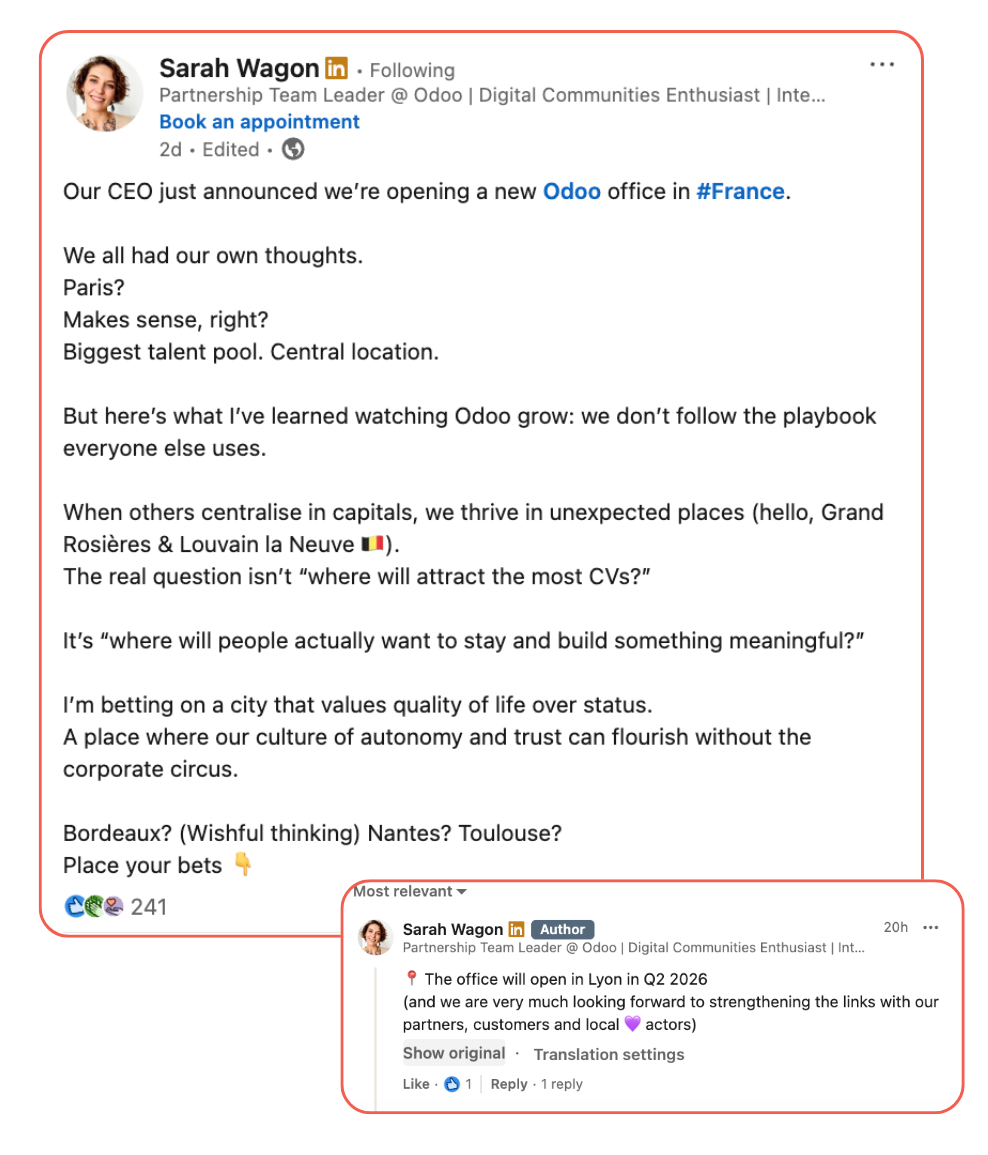
Odoo to open a new office in France
Fabien Pinckaers has announced that Odoo will open a new office in France by Q2 2026!
Internal sources say the new HQ will be in Lyon.
Odoo often follows this approach when expanding abroad: skipping expensive capitals and choosing vibrant second-tier cities that support growth.
Lyon has a strong SMB ecosystem and is close to Italy and Switzerland. It’s a smart move for Odoo’s European expansion - and the community is already buzzing with excitement!
Odoo founder defends low margins
Odoo’s upcoming 2026 price increases have sparked online debate about the company’s financial model.
Critics noted low revenue per employee (~EUR 79K) and small average contract values (~EUR 2,575), questioning sustainability.
Fabien Pinckaers addressed the debate directly: Odoo intentionally keeps margins low to reinvest in the product and grow sustainably. In his words: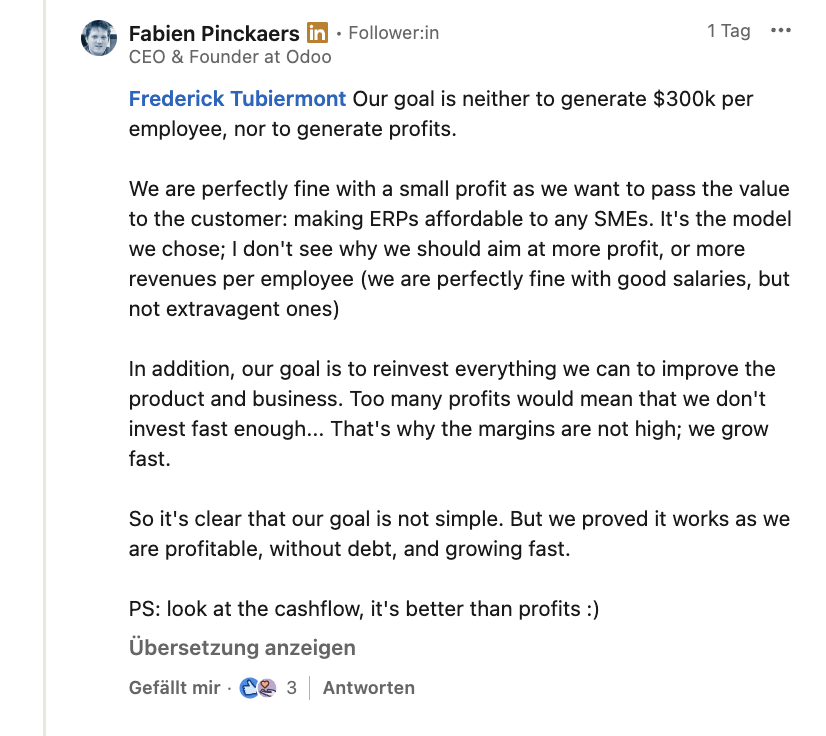
The numbers confirm the approach: in 2024, Odoo generated EUR 426 million in revenue but only EUR 314K in profit.
The upcoming price adjustments are a necessary step to maintain support and continue product development.
Odoo discusses e-invoicing and free Peppol access
And the e-invoicing saga continues:
Odoo has released its latest "Unplugged" on social channels, dedicating the entire episode to discussing Peppol (Pan-European Public Procurement Online).
In-house experts from Odoo’s Consulting, R&D, and Product teams sat down to outline the technical and practical shifts regarding the upcoming e-invoicing mandates.
Key takeaways:
- Peppol is a decentralized network for exchanging structured invoices (XML files).
- It moves away from "guessing" data via OCR to 100% accurate data mapping between systems.
- Odoo acts as a free & unlimited Access Point, while competitors are still charging up to €0.45 per invoice.
- Peppol prevents fraud via new KYC measures (like "It's Me" in Belgium).
- It can be activated with 4 clicks to start sending/receiving invoices globally.
As e-invoicing will become mandatory for all EU B2B transactions by 2030, pressure is rising for companies to adapt quickly.
Community talk
All the hot topics and discussions Odoo users are buzzing about this month.
Decade-old Odoo PostgreSQL issue finally fixed
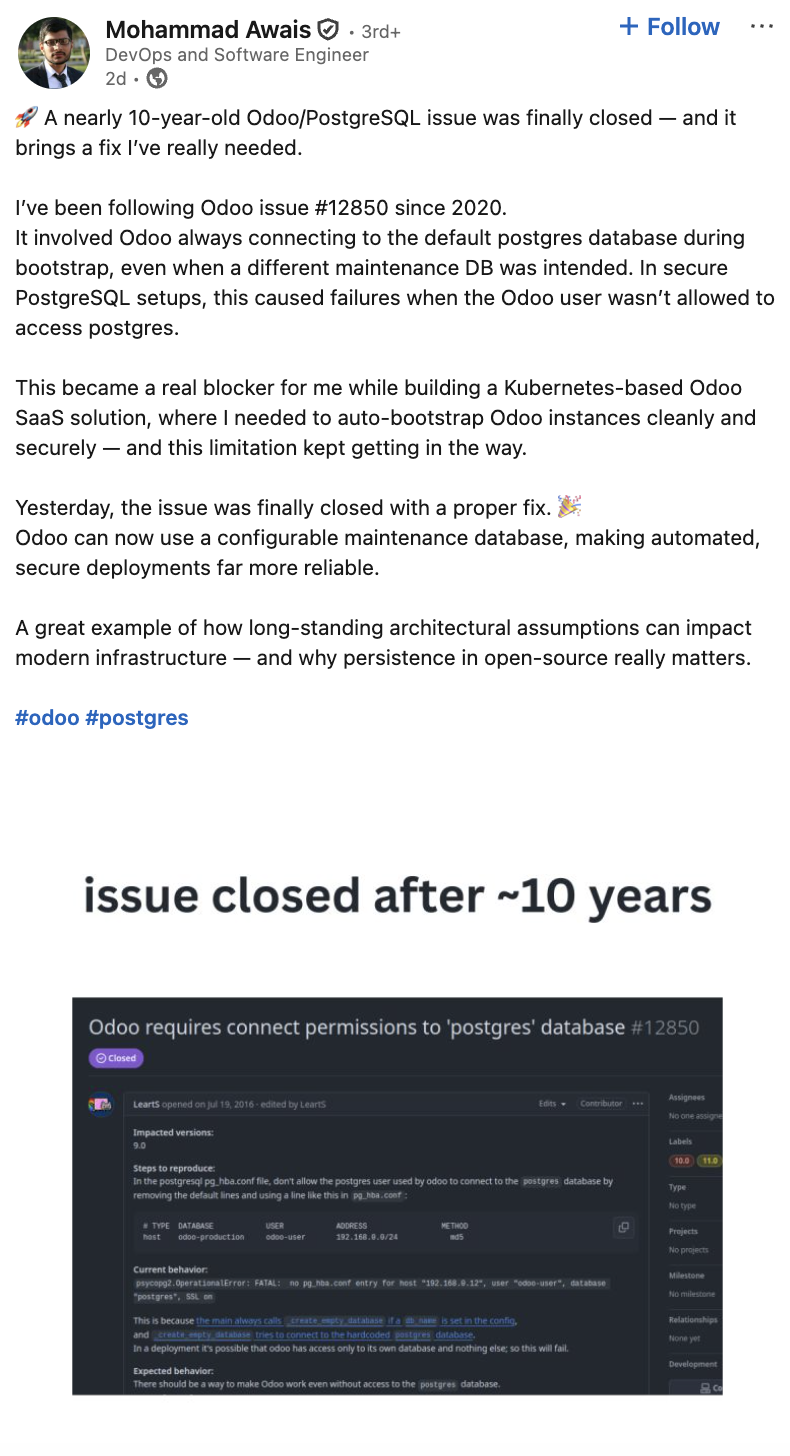
An Odoo user took to LinkedIn to celebrate a fix… of a 10-year-old issue!
The long-standing issue (#12850) caused Odoo to connect to the default 'postgres' database at startup, even when a different maintenance DB was specified. This often led to failures in secure PostgreSQL environments where the Odoo user didn’t have access to 'postgres'.
With the fix, users can now choose which database to use for maintenance or any other purpose.
Old design choices can still cause headaches in modern systems. This fix shows that even decade-old problems are worth solving. And users will definitely notice.
Users praise early Odoo 19 upgrades
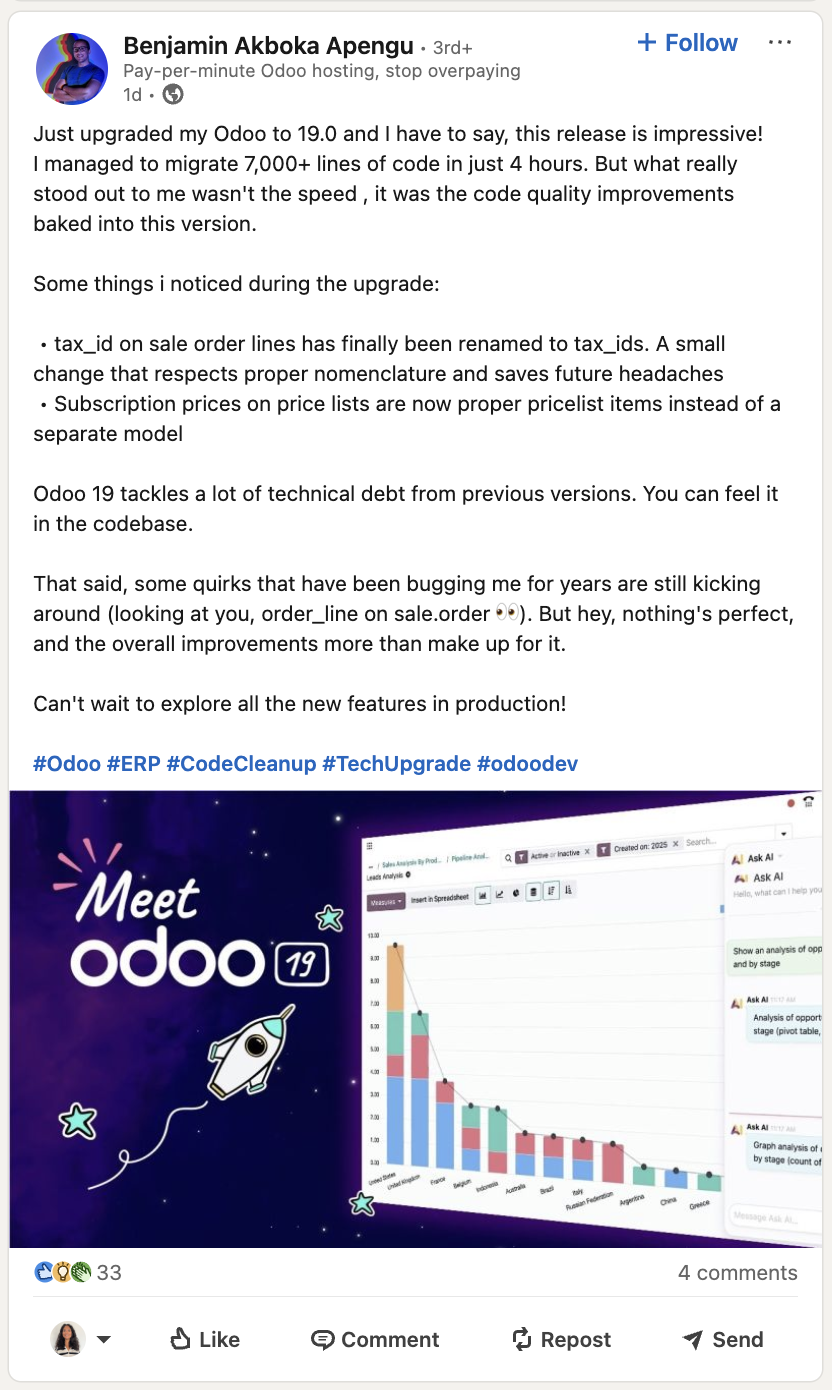
The Odoo community has begun upgrading to version 19, and early feedback has been largely positive.
Users are highlighting:
- Faster migration: one user reported upgrading 7,000+ lines of code in under 4 hours
- Improved pricelists, particularly for subscriptions
- Cleaner, more consistent code.
Odoo now holds 20% market share in Belgium
A recent community discussion has shed light on just how dominant Odoo has become in its home market.
After a LinkedIn post from an Odoo employee raised a few eyebrows, claiming that 1 in 5 Belgian companies now run on Odoo, CEO Fabien Pinckaers stepped in to verify the numbers with a more transparent breakdown.
His data reveals that Odoo is currently used by roughly 37,000 active companies in Belgium (out of the ~200k total Belgian companies with at least one employee).
The split between paid and free users:
- 17,000 are paying subscribers.
- ~20,000 are on free databases (Community or One-App-Free), including roughly 10,000 clients managed directly by accounting firms.
Price increases rumored for the US and Canada in 2026
Word in the community is that Odoo plans to implement a 30% price increase for the US market, effective January 2026.
It is also said that a dedicated Canadian price list is on the way, likely matching the new US pricing converted into CAD.
Still, nothing was confirmed by Odoo officially at this stage.
News from the ERP world
Headlines from the ERP world you shouldn’t miss.
EU delays strict AI rules for high-risk systems
The European Commission plans to delay key parts of the EU AI Act, pushing stricter requirements for high-risk AI systems back by 16 months.
Instead of applying from August 2026, the toughest rules would now take effect in December 2027. The delay applies to high-risk uses such as biometric identification, AI in hiring decisions, and systems used in critical infrastructure.
The move is part of the Commission’s “Digital Omnibus” initiative, aimed at reducing regulatory overlap and easing pressure on businesses. Officials say compliance deadlines should only apply once technical standards and guidance are available.
The proposal also includes a notable concession to industry: developers would be explicitly allowed to process sensitive personal data to detect and reduce bias in AI models, addressing long-standing concerns that GDPR rules hindered testing and safety work.
While the AI Act has been in force since August 2024, many obligations already apply, including risk classification, documentation, and labeling. The postponement mainly affects the most demanding requirements for high-risk systems.
The changes must still be approved by the European Parliament and Council, but industry support is strong. For now, companies are advised to plan around a December 2027 deadline, while continuing governance and compliance work amid ongoing regulatory uncertainty.
ServiceNow plans $7B cybersecurity acquisition
The enterprise software provider ServiceNow is in advanced talks to acquire Armis, a cybersecurity startup specialising in protecting IoT and unmanaged devices. Valued at up to $7 billion, this could be ServiceNow’s largest acquisition ever.
The deal is meant to strengthen ServiceNow’s security offerings. By integrating Armis’ technology into its workflow platform, ServiceNow could detect security events and automatically manage incidents, risks, and compliance. The acquisition would expand the company’s enterprise security capabilities and product portfolio.
Investors reacted sharply. ServiceNow’s shares fell nearly 12% on Monday, reflecting multiple concerns, such as:
- High pricetag: the $7B valuation is about 23x Armis’s annualised sales.
- Shareholder dilution: ServiceNow may issue new shares to fund the deal, potentially reducing the value of its existing stocks.
- Acquisition pace: ServiceNow has already completed major deals in 2025, including Moveworks ($2.9B) and Veza (~$1B), which strains management focus and capital.
- Fears about future growth: Analysts are also cautious about broader trends. Generative AI could increase productivity at client companies, potentially reducing the demand of subscription licenses, which may limit ServiceNow’s revenue growth.
SAP confirms end of new Business ByDesign sales
SAP has announced that it will stop offering Business ByDesign to new customers on April 20, 2026.
Existing customers will continue to receive updates and support, with no end-of-maintenance date planned.
Once seen as a major growth opportunity for the mid-market, Business ByDesign never reached its expected scale. Early technical issues, complexity, and high costs limited adoption, and current user numbers are unclear.
Internally, the product has low priority, and maintenance has largely been outsourced for years.
The discontinuation highlights a broader trend: SAP is focusing on modern cloud ERP solutions, leaving some mid-market customers to navigate complex migrations.
How many ByDesign users will move to S/4HANA Cloud or Business One remains uncertain.
Oracle's AI spending raises investor concerns
Oracle’s latest earnings report sent shares down more than 10% after the company missed revenue and profit expectations.
While total revenue grew 14% to $16.1 billion and its AI business surged 68%, Wall Street is increasingly cautious about the cost of Oracle’s AI investments.
Capital expenditures for fiscal 2026 are expected to reach $50 billion, $15 billion more than previously forecast, as Oracle expands AI infrastructure for major clients including OpenAI, Meta, and Nvidia. The spending is largely debt-financed, and profits from these AI investments remain uncertain.
Investors are concerned that heavy AI spending, combined with aggressive borrowing, could outpace near-term returns.
While Oracle continues to win large AI contracts, the market is questioning whether the company can turn this infrastructure investment into sustainable profits.
AI expected to control $15 trillion in B2B transactions
Gartner predicts a massive shift in how businesses will buy from each other in the near future.
According to a recent study, AI agents will negotiate and execute over $15 trillion in global B2B purchases, by 2028.
Consequently, nearly 90% of B2B transactions could switch to "machine-to-machine" mode, cutting humans out of the loop almost entirely.
This shift will create a competitive divide. Organisations using multi-agent AI for 80% of customer-facing processes are expected to outperform their competition significantly.
ERP vendors across the board are already racing to integrate AI agents into their platforms. Judging by these new forecasts, it doesn’t look like they will slow down anytime soon.
Let’s talk Odoo
Reach out to our Odoo experts to see everything Odoo can do and how to tailor it to your business.