The short answer
Traefik brings a lot to Odoo hosting today. It sees new instances start and adds their routes by itself. It requests and renews free HTTPS certificates on its own, and it applies changes live, with no reload. That makes it a strong fit for setups with staging copies, custom domains and regular releases.
NGINX still makes sense for a few sites that rarely change. Our view comes from moving about 160 production Odoo servers on Shoovels from NGINX to Traefik.
What a reverse proxy does
Every request to an Odoo instance passes through a reverse proxy first. It holds the HTTPS certificate, works out which Odoo instance a request is for, and passes it on. When the proxy gets something wrong, users see an error page or a certificate warning, even if Odoo itself is fine.
Odoo also relies on the proxy for live chat and notifications. These run on a separate Odoo worker, and the Odoo deployment documentation asks the proxy to send all /websocket requests to it.
NGINX and Traefik both do this job. NGINX arrived in 2004 and became the default front door of the web. Traefik started in 2015 and reached version 1.0 in 2016. It was built for servers where applications start, stop and move all the time.
Which Odoo hosting setups does this apply to?
Every Odoo setup has a reverse proxy. What differs is who chooses and runs it.
| Hosting setup | Who runs the proxy | What this article helps with |
|---|---|---|
| On-premise or your own cloud server | Your IT team | Choosing a proxy and setting it up for Odoo |
| Odoo on Kubernetes | Your IT team, through an ingress controller | Replacing the retired ingress-nginx |
| Managed hosting by a partner or platform | Your hosting provider | Knowing what to ask your provider about certificates and routing |
| Odoo Online and Odoo.sh | Odoo | Understanding the trade-offs if you plan to move |
If you compare hosting providers, ask how they renew certificates and how a new domain or staging copy gets its route.
Which settings matter with any reverse proxy?
Odoo's deployment documentation names three settings. They apply to NGINX and Traefik alike:
- Proxy mode: start Odoo with proxy_mode enabled, so it sees the visitor's real address, hostname and protocol. Enable it only when Odoo really runs behind a proxy
- Live chat route: send every request that starts with /websocket to the live chat worker, which listens on the gevent port (8072 in Odoo's example)
- HTTPS redirect: send plain HTTP visitors to the secure address automatically.
Our migration added one more check: make sure slow uploads cannot block Odoo's workers. The lessons below explain why. For the rest of your security setup, read our guide to the Odoo IT security setup.
How do NGINX and Traefik compare?
The difference that matters is who tells the proxy what to do. With NGINX, a person or a script writes a config file. Traefik asks the server what is running and sets itself up.
| Criterion | NGINX | Traefik |
|---|---|---|
| How it learns about a new site | Someone writes a config file and reloads it | It sees the new application start and adds the route itself |
| HTTPS certificates | Usually a separate tool; a built-in module exists since 2025 | Built in: it requests and renews free Let's Encrypt certificates |
| Applying a change | A reload, after a manual or scripted check | Live, with no reload |
| Seeing what it does | Basic counters, more with add-ons or the paid edition | Metrics, tracing and a live dashboard in the free edition |
| Where it is stronger | Serving files, caching, raw efficiency | Platforms where applications change every week |
NGINX has been catching up. According to the NGINX blog, it added its own certificate module in August 2025. It started as a preview that handled only the simplest kind of check.
Why did we move 160 Odoo servers to Traefik?
Our first platform ran NGINX on every customer server. A script wrote one config file per Odoo instance. Every new instance, staging copy or custom domain meant writing that file again and reloading NGINX.
That worked, but the files slowly drifted apart. When we looked into our recurring certificate failures, we found two causes:
- Drifting templates: config templates had drifted apart from customer to customer
- Timing: the certificate check broke whenever it ran in the middle of a deploy.
What changed after the switch
Most of the change is invisible to customers, which is how it should be. From the outside, four things changed:
- Automatic HTTPS on custom domains: once a domain's DNS points to us, Traefik requests its certificate and renews it before it expires
- Separate routing per instance: the instructions that tell Traefik how to reach an Odoo instance sit next to that instance, so a change for one customer does not rewrite another customer's settings
- Sleeping test systems: a staging instance nobody uses pauses, then wakes on the next visit after a short waiting page
- Private instance names: our own subdomains share one wildcard certificate, so a new instance's name never shows up in the public logs that record every certificate issued.
A typical case: a customer adds shop.example.com to its instance and points the domain at us. Our platform checks the DNS until it matches, tells Traefik about the new name, and Traefik fetches a certificate. The customer never opens a ticket, and nobody logs in to a server.
How we kept the migration low-risk
We switched one server at a time, each behind a flag we could flip back. A problem on one server could not spread to the rest. Customers kept their domains and settings.
How a request reaches an Odoo instance
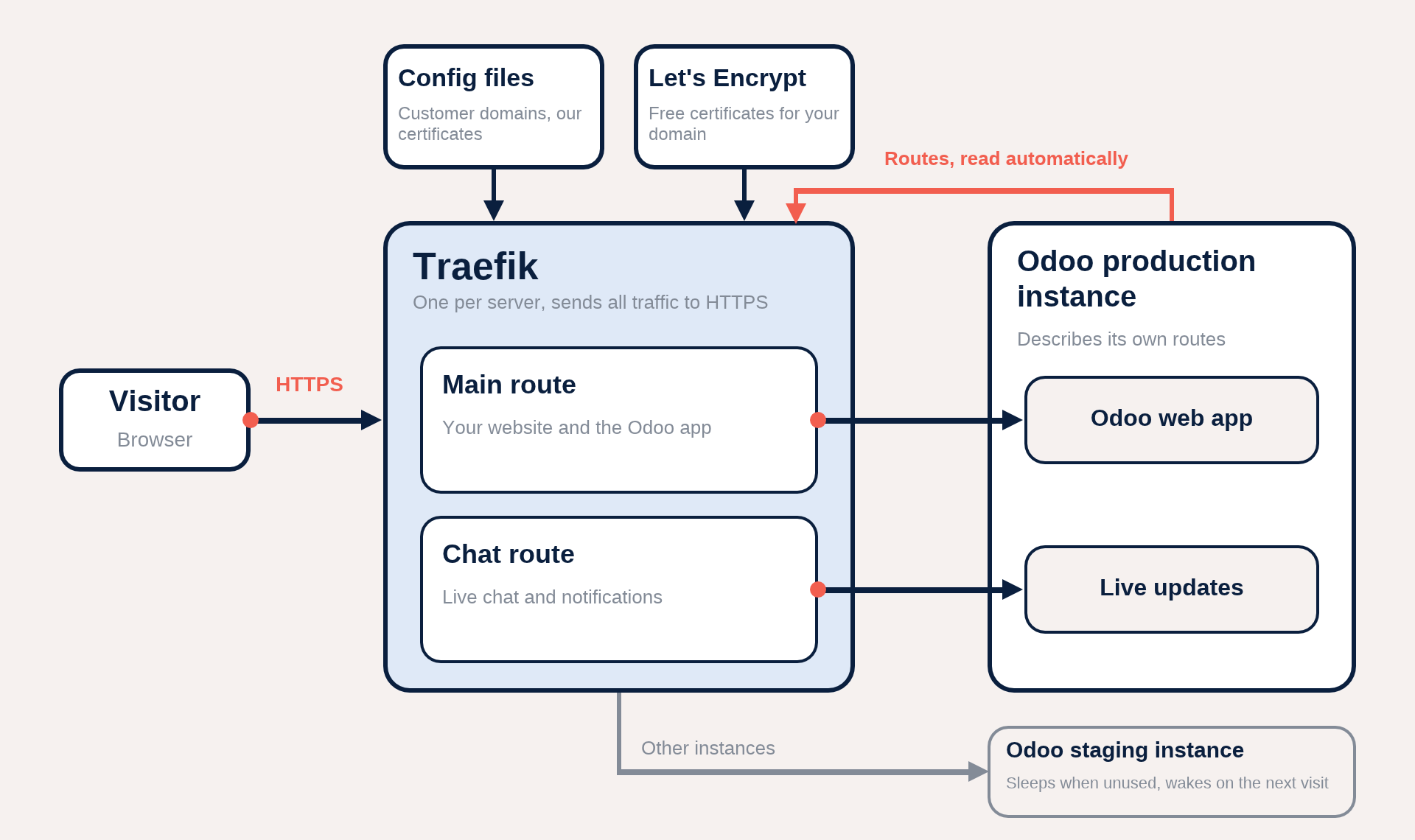
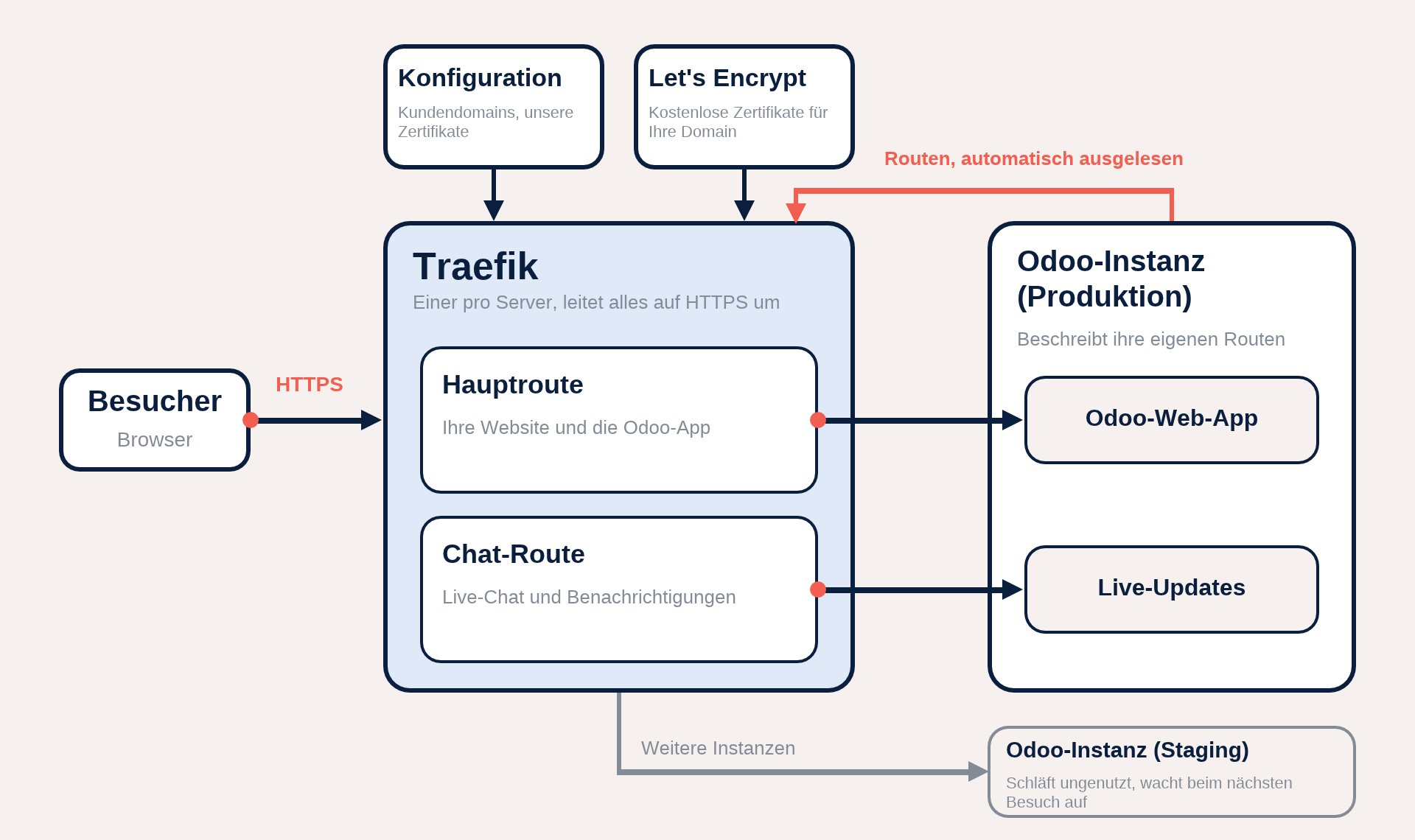
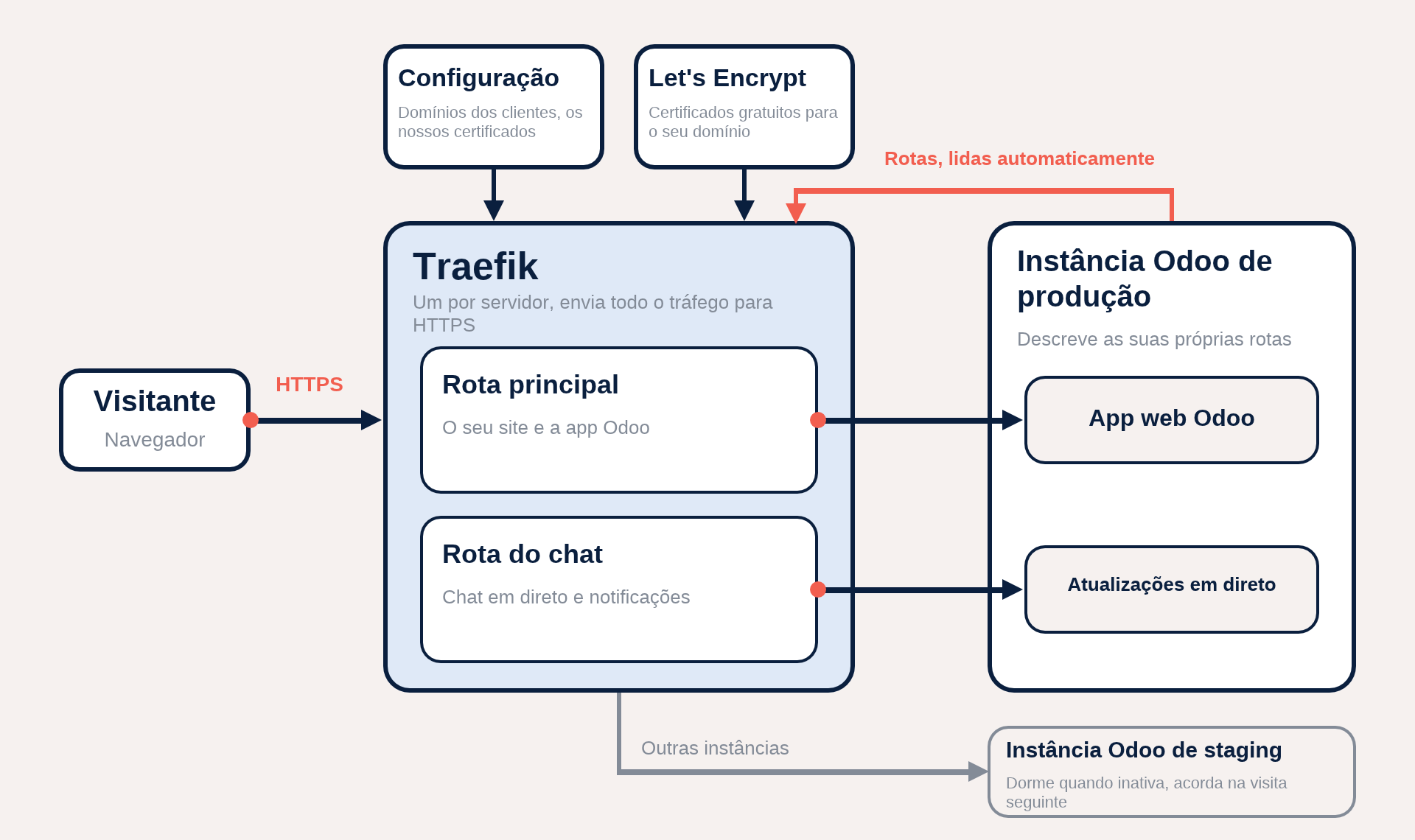
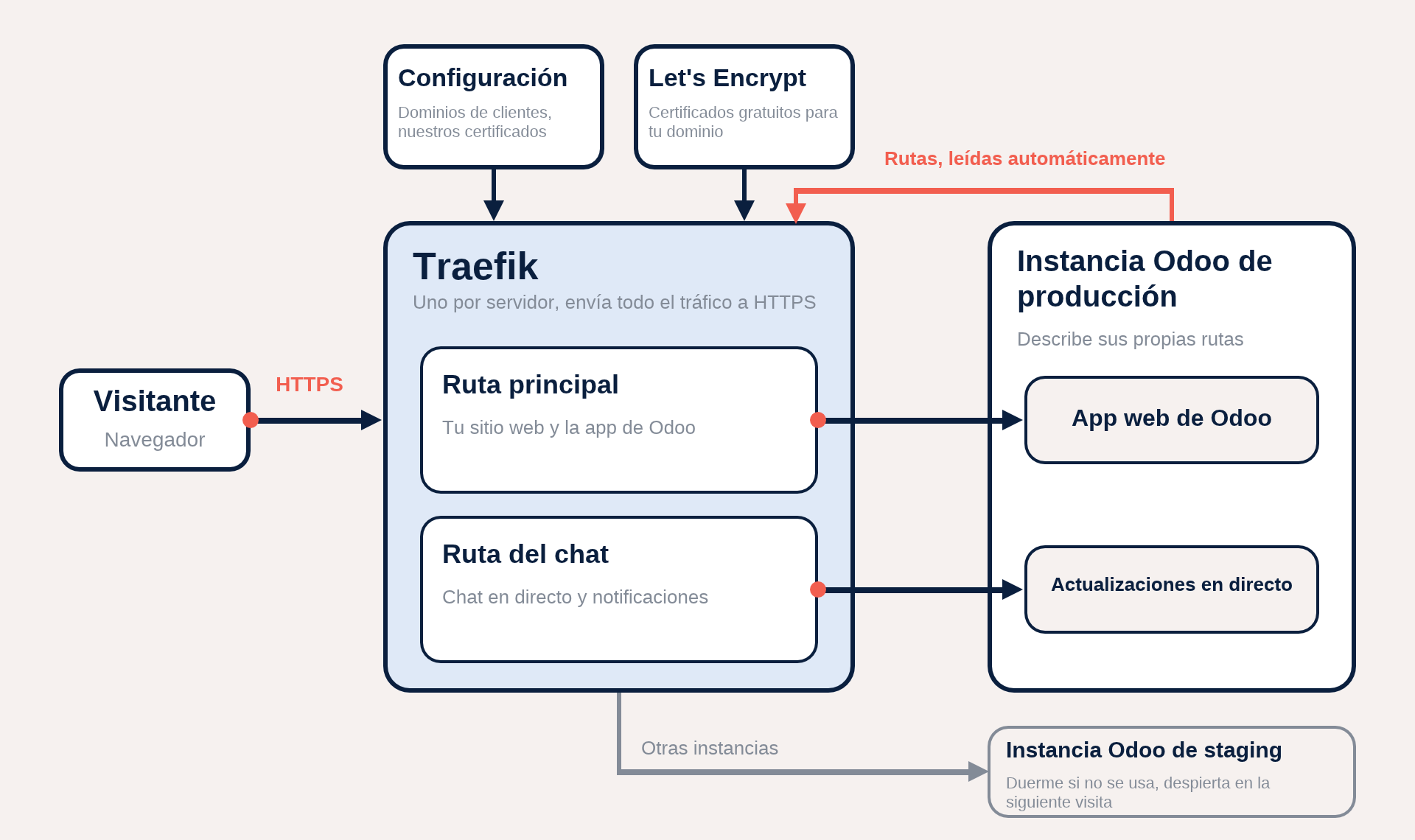
One Traefik per server routes every Odoo instance.
A visitor's request reaches Traefik over HTTPS. One route sends the page to Odoo, and a second carries live chat and notifications. Traefik learns both routes from the instance itself.
Why are so many teams switching now?
Three changes push teams to review their proxy setup.
Applications no longer sit still
On container platforms such as Docker, each release can move an application to a new address. A proxy that waits for a person to edit a file falls behind.
Automatic HTTPS is now expected
Customers bring their own domains and assume the padlock will just appear. Traefik has handled certificates on its own since version 1.0 in 2016.
Kubernetes retired ingress-nginx in March 2026
Many teams on Kubernetes used a free component called ingress-nginx to handle incoming traffic. The Kubernetes project retired it in March 2026, because only one or two people were still maintaining it. Since then it gets no security fixes. According to the Kubernetes Steering and Security Response Committees, roughly half of cloud native environments relied on it.
Traefik is a common replacement because it understands part of the old component's settings, so less has to be rewritten. NGINX itself is not affected. Only that one component was retired.
What did we learn from the migration?
Three lessons are worth passing on to any team or provider that runs Odoo servers.
Check the defaults you rely on
NGINX waits for an upload to arrive in full before passing it on, while Traefik passes it through as it arrives. A few slow uploads could then tie up all of Odoo's workers, so we turned the waiting back on.
Automatic renewal only covers certificates Traefik requests itself
A certificate you hand Traefik as a file still needs its own renewal and its own alarm. We learned that when one expired on our own platform.
Strict settings need a complete list
We told Traefik to refuse any domain it holds no certificate for. One domain behind a CDN had none on its server and failed for about 15 minutes until we added it.
Should you use NGINX or Traefik?
The right choice depends on how often your setup changes. Stay on NGINX if your sites are few and rarely change, if you depend on its caching, or if your team knows it well. NGINX is still the better pure web server, although for Odoo that rarely matters, because Odoo itself is almost always the slowest part. A stable setup that nobody needs to touch is not a problem to solve.
Move to Traefik if applications come and go every week, or if your customers bring their own domains. If you run the retired ingress-nginx component, plan your move now, because it no longer gets security fixes.
Either way, list every NGINX default you rely on before you switch. Then move one server at a time, with a way back for each.
Not sure who should run your Odoo servers? Our guide What's the best hosting option for your Odoo? compares Odoo.sh, on-premise and Shoovels. For your own servers, read Odoo on-premise hosting: when to choose it and how to set it up.
FAQ
Who needs to choose a reverse proxy for Odoo?
Companies that run Odoo on their own servers or in their own cloud, and the partners or hosting providers who run Odoo for others. On Odoo Online and Odoo.sh, Odoo makes this choice for you.
Which reverse proxy does Odoo recommend?
Odoo's deployment guide uses NGINX in its sample configuration. It also says HTTPS termination works with just about any proxy, as long as proxy mode is enabled and /websocket requests reach the live chat worker.
Does Odoo live chat work behind Traefik?
Yes. Send every request that starts with /websocket to Odoo's gevent port, exactly as you would with NGINX. Without that route, live chat and notifications stop working.
Does Traefik renew SSL certificates automatically?
Yes, for certificates it requests itself from Let's Encrypt. Certificates you hand to Traefik as files still need their own renewal and expiry alert.
Sources
- Ingress NGINX Retirement: What You Need to Know, Kubernetes SIG Network
- Traefik and Ingresses with NGINX annotations, Traefik docs
- NGINX Introduces Native Support for ACME Protocol, NGINX blog, 12 August 2025
- Traefik ACME certificate resolver, Traefik docs
- Controlling nginx, nginx.org
- Sablier, the tool that puts idle instances to sleep
- System configuration, Odoo documentation
- Ingress NGINX: Statement from the Kubernetes Steering and Security Response Committees, January 2026.