Most ERP projects don’t fail during implementation.
They fail before the first configuration step, when expectations are set wrong, the right people aren’t on board, and nobody has mapped how the business actually runs.
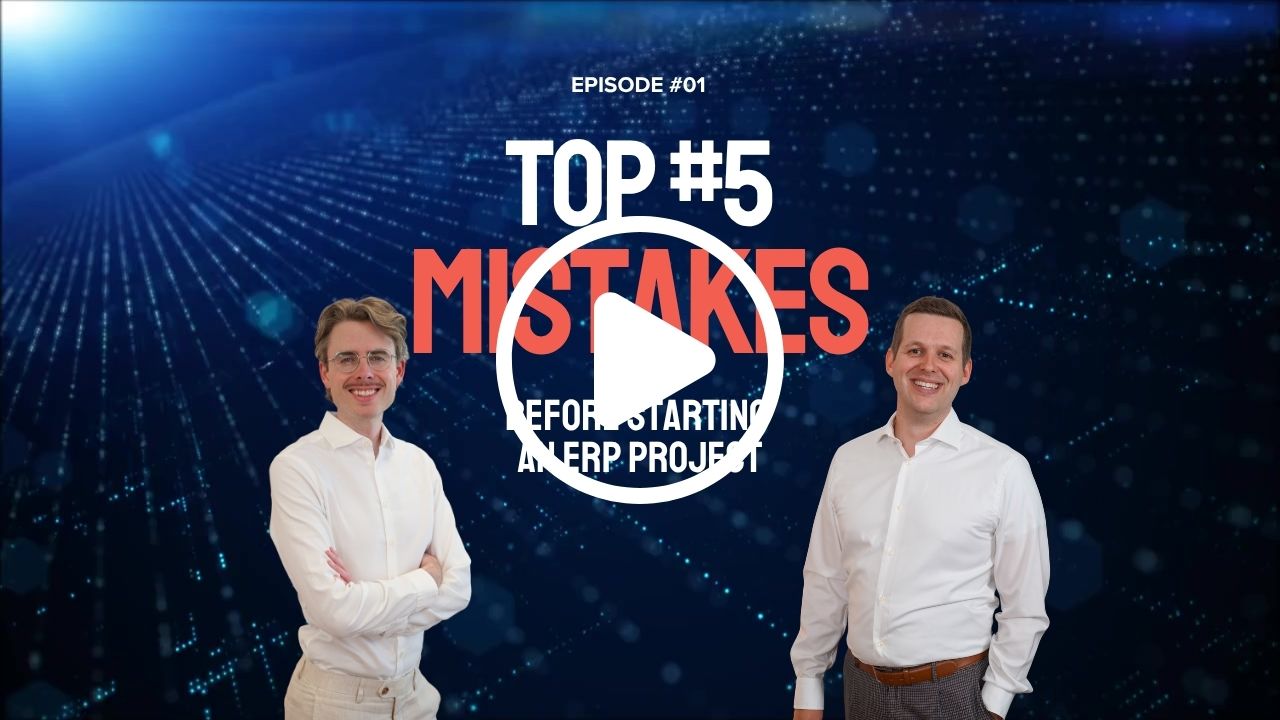
In the first episode of our podcast Who Changed the System?, Simon (Co-Founder and Managing Partner) and Samuel (Director & Team Lead Solution Consulting) walk you through the five mistakes we see most often.
Mistake 1: Expecting the ERP to fix everything
We hear the same expectations over and over: the ERP should make everything better, it has to pay for itself, processes should run leaner, and all problems should disappear. Many companies see a big, expensive system as the cure for issues that have little to do with software. Unclear responsibilities, workarounds in Excel, and a leadership team that hasn’t agreed on its goals are common examples.
Ask yourself before you start: What exactly is the problem we want to solve, and would a new system actually fix it on its own? If the answer is “not sure,” the project should begin with a diagnosis, not with a software selection.
Mistake 2: Outsourcing the project and ownership
“We can just hand it over to the consultants” is probably the most expensive assumption in ERP projects. A partner can design, configure, and migrate. But the people who know the daily work have to be part of the project, because they know where processes really break.
Look for key users: people who are motivated, have an overview of the processes, and know what really happens day to day. Motivation matters more than skill here. Colleagues who see how the system makes their work easier will push it forward. Plan their time upfront. A project that runs alongside daily business without dedicated resources will stall.
Mistake 3: Underestimating change readiness
Leadership is often more open to change than the team that has to work with the new system. Resistance rarely shows up in the big meeting. It shows up quietly. A colleague keeps running their Excel sheet simply because they’re used to it, and nobody notices until go-live exposes the gaps.
What helps: name the benefit for each user early, address their concerns, and plan quick wins. If some features make daily work easier right away, put them in the first phase. People stay committed to a project that consistently makes their day better.
Mistake 4: Digitising a broken process
“Garbage in, garbage out” is an old saying, and it still holds. A broken process that gets digitised is just a broken digital process, only faster.
Before anything is configured, map the processes from start to finish. Ask why each step exists and what business need sits behind it. Then design the process around that need instead of copying the old one 1:1. Simon’s observation from many selection projects: ERP systems are often chosen from long requirement lists, and two-thirds of the functions are never used. A feature that exists in the standard software doesn’t help if it doesn’t fit the way your business actually works. Think in processes, not features.
Mistake 5: Starting with unclean master data
Years of master data, duplicate numbers, unclear fields, and old entries that nobody ever removed. Moving all of it into a new system is a bad idea. Clean data is the foundation of a smooth migration.
The good news: AI makes cleanup and normalisation much faster than it used to be. The catch: it still has to happen before the migration, not after go-live.
Before you start: a checklist
- Is the problem defined, and is software the right answer to it?
- Are key users named, and do they have the time?
- Has someone internal taken ownership of the project?
- Have the processes been mapped from start to finish?
- Is the master data cleaned up, or is the cleanup planned?
FAQ
When should a concept phase happen?
Before the software is chosen, or at the latest before configuration starts. A concept phase clarifies processes, requirements, and budget, so the selection is based on facts.
Do we need an internal project owner?
Yes. A partner can support the project, but decisions and ownership have to sit inside your company.
Can AI help with master data?
Yes. AI can clean and normalise data much faster than manual work. It still needs a clear target structure, and someone has to check the results.
Want to check whether your ERP project is ready to start?
Book a free consultation with our team.