The UK ERP Funding Guide
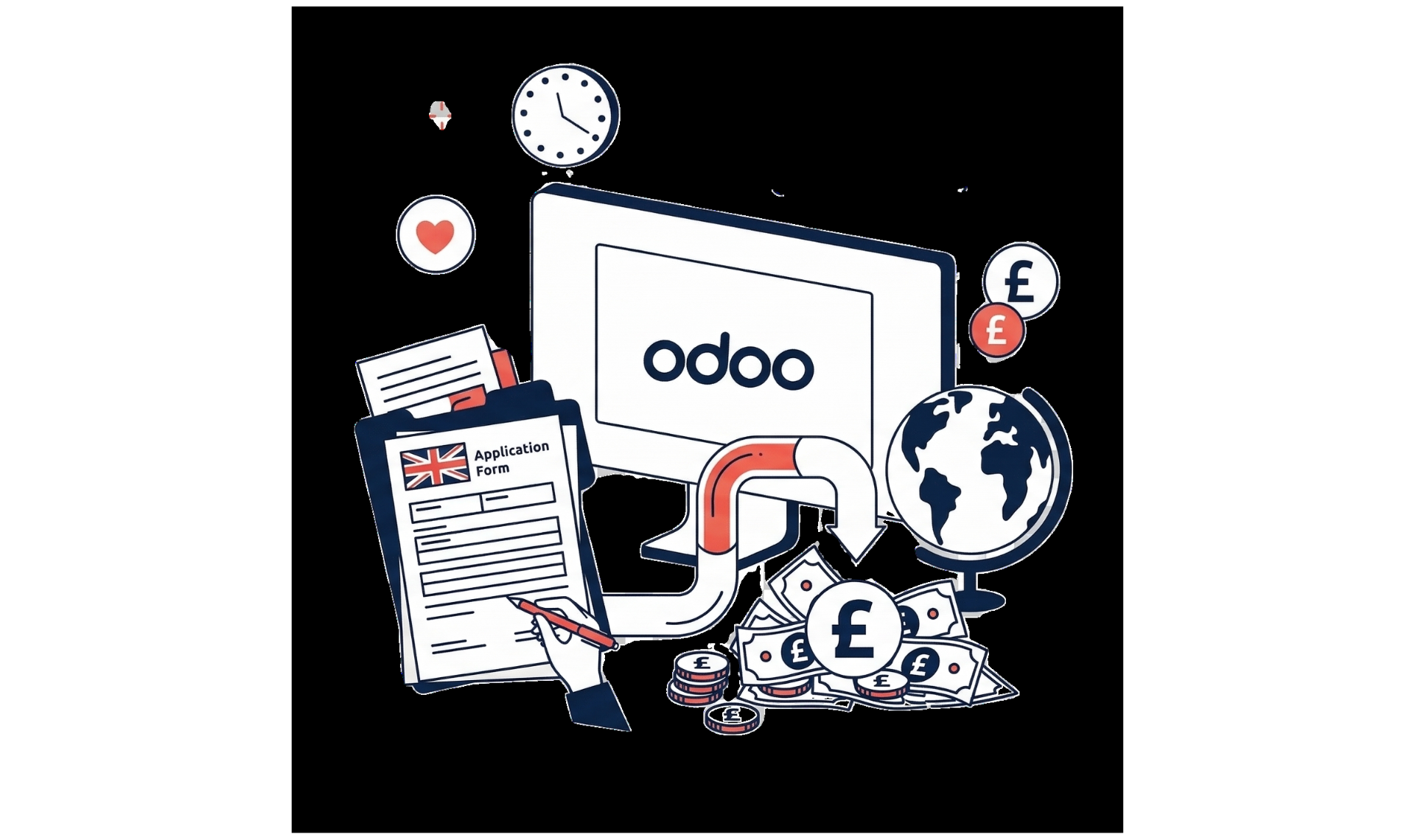
This guide provides a logically categorised, up-to-date directory of the funding routes (Grants, Loans and Support Programmes) available for UK ERP projects.
Disclaimer
This guide has been compiled from publicly available information to provide a general overview of the ERP funding landscape in the UK. We are an ERP consulting and implementation company, not financial advisors. We do not offer specific funding, grant writing, or financial consulting services. Funding rules change constantly, and we strongly advise consulting with a specialist financial advisor or the relevant funding body before making any capital commitments.
What You Should Know Before Applying
Before exploring specific programmes, you must understand how UK business funding actually operates in practice:
1. Timing & Approval
- The "No Prior Commitment" Rule: Do not sign any contracts or pay deposits before your grant offer letter is formally signed. If the project "starts" (legally or physically) before approval, it becomes ineligible.
- Short Application Windows: Funds often open and close within 4 to 8 weeks. You must have your business case and quotes ready before a fund opens to avoid missing the deadline.
- Project Duration Caps: Grants have fixed "hard stop" dates. If your ERP implementation overruns the grant's completion deadline, you will lose the final payment milestones.
2. Procurement & Supplier
- The "3-Quote" Rule: You cannot simply pick a preferred partner. You must provide three competitive quotes from independent vendors.
- Functional Requirements Document (FRD): All quotes must be based on the same FRD to ensure a like-for-like comparison. Assessors will reject applications where scopes differ between bidders.
- Certified Vendors: Some schemes require you to select from a pre-approved list of "Quality Assured" consultants or vendors.
3. Financial & Cash Flow
- Payment in Arrears: Grants are almost never paid upfront. You must pay the supplier 100% of the invoice, prove the work is live, and then claim the grant percentage back. You need the working capital to float the project.
- The VAT Trap: Grants are calculated on net costs only. You must cash-flow the 20% VAT yourself. Even if you reclaim it later via HMRC, it represents a significant upfront cash requirement.
- Match Funding: Expect to cover 50% to 70% of costs from your own reserves. 100% grants for commercial software do not exist.
- CapEx vs. OpEx: Many grants prefer funding "one-off" implementation costs (Consultancy/Training) rather than ongoing SaaS subscription fees.
4. Legal & Subsidy Control
- MFA Thresholds: Most SME grants operate under Minimal Financial Assistance (MFA) rules. You are limited to £315,000 in total subsidies over a rolling three-fiscal-year period. You must declare previous grants (including some COVID-era recovery funds) to ensure you don't breach this limit.
- Streamlined Routes (The Exception): Larger national schemes (like Innovate UK) may use "Streamlined Routes" with much higher limits, but these come with stricter eligibility criteria and different match-funding ratios.
- No 'Double Funding': You cannot use two different grants to pay for the same invoice. However, you can use Grant A for technical setup and Grant B for staff training.
5. Risk & Value Assessment
- Strategic Alignment (GVA): Assessors ignore software features. They care about Gross Value Added: measurable productivity gains, job creation, or carbon reduction.
- Scope Creep Risk: Grants are capped at the original offer. If your £50k project balloons to £80k during the build, the grant stays fixed at the original percentage of the initial £50k.
- Ineligible Internal Costs: You generally cannot claim for your own staff’s time spent on the project. This "internal labour" is an unfunded cost you must absorb.
The Hierarchy of UK Funding Networks
In the UK, funding is distributed across different tiers depending on your sector, location, and technology.
much. Produktkatalog
Hier finden Sie Unterstützung und Informationen zu allen much.-Produkten, die Sie erworben haben. Folgen Sie den untengenannten Schritten, um Ihr Modul einzurichten. Bei Fragen steht Ihnen unser Produktteam jederzeit zur Verfügung.
AI & automation
Odoo AI Automated Actions
Optimieren Sie Ihre Odoo-Workflows mit intelligenter Automatisierung. .
eCommerce

Shopify Integration
Synchronisieren Sie Produkte, Bestellungen und Bestände aus Ihrem Onlineshop.

Shopware Integration
Synchronisieren Sie Produkte, Bestellungen und Bestände aus Ihrem Onlineshop.

Procuros Integration
Streamline B2B transactions with EDI connections.

ChannelEngine Integration
Zentrale Steuerung Ihres Multichannel-Vertriebs an einem Ort.

WMS Integration
Verbinden Sie Odoo mit 3PL-Logistikdienstleistern.

Payment Provider Integration
Importieren und gleichen Sie Transaktionen ab.
Deutschland-spezifische Module

Deutsche Dokumentvorlagen
Professional & compliant business documents (DIN 5008)
German data & translations
Enhanced translations, regional data & asset depreciation tax rules.

DATEV-Integration, CSV- und XML-Export
Streamline accounting with automated entries export.
Manufacturing & supplier management
Erweitertes Rückverfolgbarkeitsmodul
Smarter repair & service tracking for serial-tracked products.
Lieferanten-Compliance-Modul
Überwachen Sie die Lieferantenkonformität, bevor Sie Bestellungen abschließen.
Einrichtung & erste Schritte
Nach dem Kauf folgen Sie bitte diesen Schritten zur Installation und Konfiguration. Die Anleitungen unterscheiden sich je nach Hosting-Umgebung.
Schritt 1: Modulempfang
Sie erhalten per E-Mail eine ZIP-Datei mit der aktuellen Version des gekauften Moduls.
Schritt 2: Deployment-Anleitung
Für Odoo.sh-Nutzer:
- ZIP-Datei entpacken.
- Modulordner in Ihr Odoo.sh-Repository hochladen.
- Änderungen committen.
- Nach Abschluss des Builds steht das Modul in Ihrer Instanz zur Verfügung.
Für Self-Hosting-Nutzer:
- ZIP-Datei entpacken.
- Modul in Ihr Git-Repository einfügen .
- Per SSH auf den Server einloggen.
- Zum Odoo-Ordner navigieren.
- addons_path in der Konfigurationsdatei anpassen.
- Odoo-Dienst neu starten.
Schritt 3: Installation
- In Ihrer Odoo-Instanz anmelden
- Apps-Modul öffnen
- Entwickler-Modus aktivieren
- Apps-Liste aktualisieren
- Modul suchen und installieren
Schritt 4: Dokumentation prüfen
Nach der Installation die Produktdokumentation lesen, um Funktionen und Konfigurationsmöglichkeiten kennenzulernen.
Choose the Right Partner to Protect Your Funding
Securing a grant is only half the battle; successfully implementing the software so you can actually claim the funds is the other.
We are one of the fastest-growing Odoo Gold Partners in Europe. Odoo is a modern, highly modular ERP suite of business apps that replaces clunky, disconnected legacy software.
Because it allows you to automate everything from accounting to the manufacturing shop floor in one system, it is exceptionally good at delivering the exact "productivity" and "efficiency" metrics that government grant assessors demand.
Hand-picked
team
We don't outsource. You work directly with our internal team of 95+ consultants and engineers, hired from the top 0.5% of applicants.
Deep sector expertise
We specialise in E-commerce, Manufacturing, Services, and Accounting - aligning perfectly with the industries most heavily targeted by UK government subsidies.
Proven success record
Because most grants are paid in arrears upon project completion, a failed IT project means you lose the funding. We have a 100% success rate. We go live with every single project we take on, ensuring your investment (and your grant claim) is secure.
Consulting & automation focus
We don't just install software; we focus heavily on business process automation. We help you plan the architecture required to pass the stringent "Value for Money" tests required by public funding bodies.
Über 100 Unternehmen vertrauen uns bereits die laufende Betreuung ihres Odoo an














































































We are happy to meet you in person!

Hamish Ritchie
Senior Solutions Consultant
You can also message us right here:

Sprechen wir über langfristige Betreuung für Ihr Odoo.
Unser engagiertes Managed-Services-Team hilft Ihnen dabei, Ihr Odoo sicher und effizient zu betreiben. Konzentrieren Sie sich voll und ganz auf Ihr Kerngeschäft – wir kümmern uns um Ihr Odoo!