If you’re a business in search of an affordable ERP, you’ve likely heard of Odoo, ERPNext, and Zoho.
But which one should you pick?
Zoho and ERPNext stand at two ends of a spectrum. Zoho One is a proprietary cloud suite built for teams that want a structured, ready-made setup.
ERPNext is a free and open-source system designed for tech-savvy organisations that want total control over their servers.
Odoo stands in the middle with a combined approach: it’s an open-source ERP designed for flexibility, fast rollout, and phased growth across departments.
See how the three systems compare and how they work for fast-growth businesses.
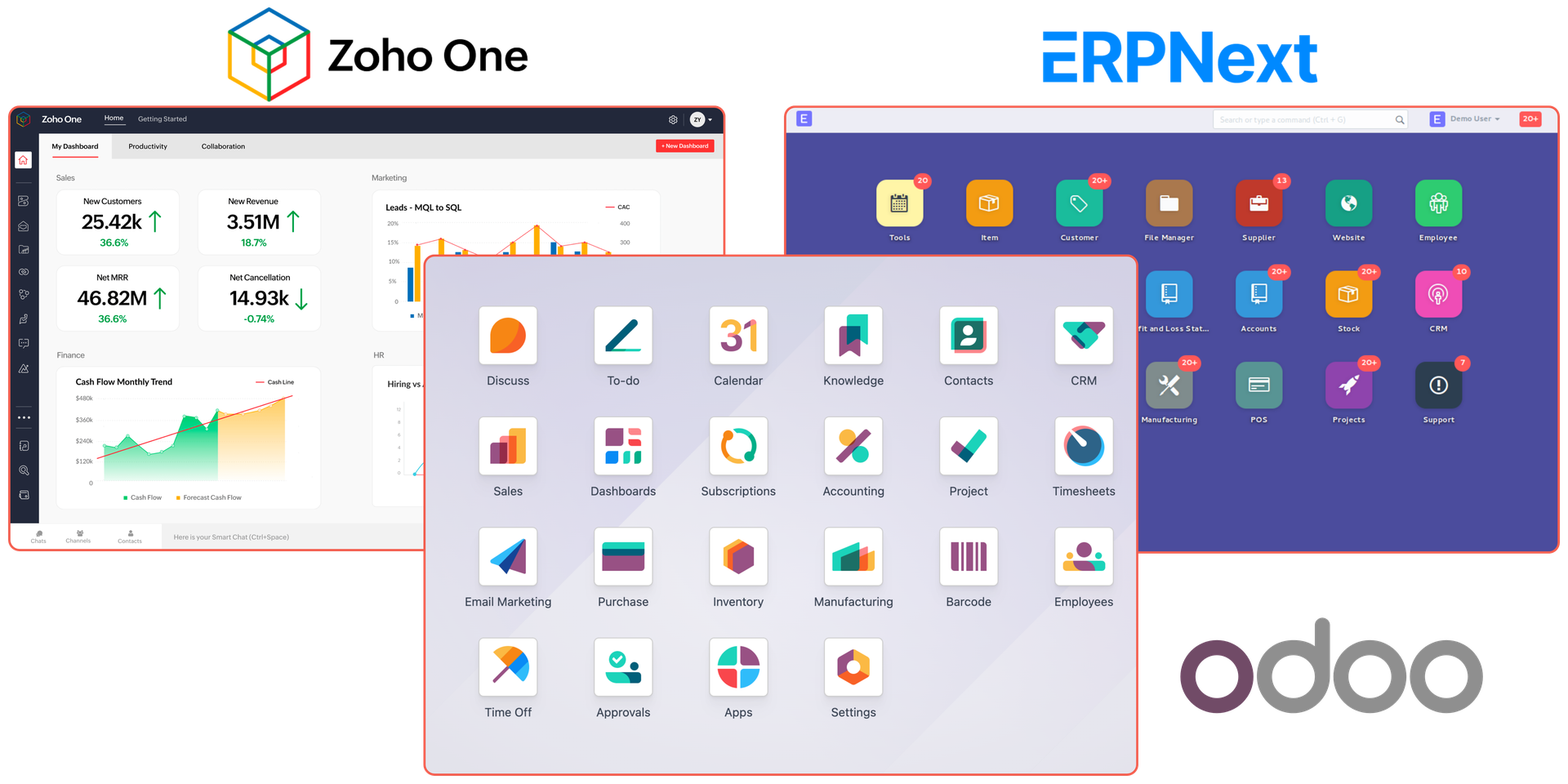
Table of contents
Odoo vs ERPNext vs Zoho at a glance
Odoo vs ERPNext vs Zoho feature breakdown
Hosting & support
Customisation
Compliance / multi-entity
Odoo vs ERPNext vs Zoho: short version (for 20 users)
When selecting an ERP, smaller growing companies often come down to three questions:
- How much do you want to spend on the software?
- How much do you need to customise it?
- How complex are your operations?
We broke down how Odoo vs ERPNext vs Zoho compare for a scale-up with a 20-user setup:
Feature | |||
Pricing* | 🥈 Low & transparent cost, with all apps included. TCO: £627 / 722€ per month | 🥇 Lowest cost, with zero licence fees. TCO: £40 / 50€ per month | 🥉 Higher cost for partial team rollouts. TCO: £1,500 / 1,800€ per month |
Hosting & technical support | 🥇 Flexible deployment & control, strong community support. | 🥈 Total control, but requires internal developers to manage. | 🥉 Vendor lock-in, proprietary managed cloud, and restricted support. |
Business scalability | 🥇 Strong for rapid growth and easy implementation. | 🥈 Strong for lean operations and single-database setups. | 🥉 Strong for sales and marketing, but weak for physical operations. |
Customisation & flexibility | 🥇 Total freedom & open-source code. | 🥇 Total freedom & open-source code. | 🥉 Restricted & low-code. |
AI | 🥇 Open, adapts to all LLMs & business use cases, native app & AI agents. | 🥉 Requires manual API integrations and custom development. | 🥈 Native Zia AI assistant, but restricted to the ecosystem |
Global compliance & regional accounting | 🥇 100+ fiscal localisation packages, more flexible and adaptable for fast adjustments. | 🥉 Relies heavily on community-maintained regional tax modules. | 🥈 Built-in global compliance & standardised control. |
*Comparison based on equal setup (20 users, plans, hosting, features); implementation, customisation, and maintenance costs excluded.
Odoo vs ERPNext vs Zoho: long version
Odoo, ERPNext, and Zoho all promise an affordable and easy-to-implement system to run your entire business.
But they deliver it through fundamentally different philosophies:
- Odoo: Modular, flexible, user-friendly, but able to handle complex operations
- ERPNext: Total data ownership and zero base software costs
- Zoho: Hands-off, all-in-one managed ecosystem that’s easy to set up.
Here’s how they match up against each other, feature by feature.
Pricing
Odoo, ERPNext, and Zoho operate under entirely different pricing models.
Please note: The comparison is made on baseline software costs and doesn’t include any costs associated with implementation, customisation, integration, maintenance, etc.

- Users: 20
- Licence type: Odoo Enterprise Custom Plan (annual subscription). This is an all-inclusive, per-user fee that provides access to every Odoo application, costing £25.96 / 29.90€ per user/month
- Hosting: Odoo.sh (PaaS). This is the required paid cloud hosting platform for advanced enterprise functions like multi-company operations, external API use, and installing custom or third-party applications, costing ~£108 / 124€ per month
- Features: All 70+ Odoo apps are included, covering Finance, Inventory, Manufacturing, Supply Chain Management (SCM), CRM, HR, Payroll, Website, eCommerce, Project, and integrated AI
- Extras: The licence includes Odoo Studio for no-code customisation, multi-company management, and external API access
- Total monthly cost (estimated): £627 / 722€.

- Users: 20
- Licence type: Open source. The software itself is entirely free with no per-user fees
- Hosting: Frappe Cloud (Private Bench). Managed hosting for your open-source instance, costing ~£40 / 50€ per month
- Features: The entire monolithic ERPNext suite is included, covering Finance, Manufacturing, Inventory, HR, and CRM
- Extras: Full root-level access to the source code
- Total monthly cost (estimated): £40 / 50€.

- Users: 20
- Licence type: Zoho One (flexible pricing), costing £75 / 90€ per user/month
- Hosting: Zoho Cloud (SaaS). Hosting, platform maintenance, security, and updates are all included within the subscription price
- Features: Access to 50+ Zoho apps, covering CRM, Books (Finance), Inventory, Desk, and Campaigns
- Extras: Includes native integration with Zoho's Zia AI
- Total monthly cost (estimated): £1,500 / 1,800€.
In a nutshell…
ERPNext is practically free, but you pay for the internal developer hours required to maintain it.
Zoho penalises startups with smaller teams with a high cost per user.
Odoo gives you a single licence that includes the entire business suite at a transparent and accessible price.
Hosting & technical support
Odoo operates on an open-source model with a freely available Community Edition and a paid Enterprise version.
Businesses can work in Odoo online, Odoo.sh, self-host on their own servers, or work with external providers to host on-premise.
This gives users maximum control but requires technical oversight, especially around updates, backups, and security.
Support is available through a global partner network and Odoo’s own Enterprise service, as well as a vast online community of users.
ERPNext is also an open-source solution.
Businesses can host it on their own private servers (like AWS or DigitalOcean) or use Frappe Cloud. This gives startups 100% ownership of their data and infrastructure.
However, support is here mostly community-driven. If the system breaks, your internal IT team is responsible for fixing it unless you pay a specialised agency on retainer.
Zoho is a proprietary cloud-first solution that runs on its own servers.
All infrastructure, security, and compliance aspects are managed by Zoho, which gives users reliability and regulatory assurance out of the box.
Support is directly through Zoho, but users are completely locked into the vendor’s infrastructure and have zero access to the backend database.
In a nutshell…
ERPNext gives you total control, which is great if you have a strong engineering team. But while the community support is strong, it lacks any customer service.
Zoho gives you zero control, which is great if you want to never think about servers or technical requirements. However, it locks you in to their proprietary cloud.
Odoo gives you the best of both worlds. With Odoo.sh, you get full access to the code, but Odoo’s team manages the cloud hosting for you.
Scalability
Odoo is designed for companies that need to adapt to rapid growth.
Its modular design allows businesses to start small and rely on software that scales with them.
For instance, they can add Sales, Inventory, and Accounting at first and gradually add more apps like Manufacturing or HR as they launch new product lines.
Vertically, Odoo can scale to support large user bases of up to 10K users.
ERPNext is built as a monolith, with all existing modules installed from day one.
It handles high-volume hardware manufacturing and distribution incredibly well.
However, because everything is pre-integrated, scaling non-technical teams (like a big marketing department) inside the platform can be very complex.
Zoho is built for sales, marketing, and service-based businesses looking to grow. Its CRM and customer support apps easily handle thousands of users and are renowned in the market.
But if your startup scales into complex operations, like multi-stage manufacturing or advanced warehouse routing, Zoho's operational modules often hit a wall.
In a nutshell…
Zoho is ideal for non-technical teams, and ERPNext is great for lean hardware startups with strong in-house IT.
Odoo is the best choice for startups that need to add complex functions (e.g. manufacturing, fleet management) and stay flexible as they grow.
Customisation & flexibility
Odoo’s open-source foundation gives companies total freedom to shape the system to their needs.
Developers can edit the source code, create custom modules, or build new features from scratch.
For simpler cases, Odoo Studio allows drag-and-drop changes without technical knowledge.
ERPNext is built on the open-source Frappe framework.
Startups have total freedom to rewrite the core logic of the system. It’s a developer's dream, but it lacks a user-friendly editor for non-technical staff to make quick changes.
Zoho uses Deluge for customisation, a proprietary low-code environment that lets teams automate workflows or design small apps without changing the core system.
This approach keeps everything stable during updates, but makes deep customisation of the core ERP logic impossible.
In a nutshell…
Odoo and ERPNext give you full customisation freedom to tailor the system to your unique startup processes.
Zoho offers system stability but very limited customisation options, forcing you to adapt your business processes to fit their software.
AI
Odoo’s AI capabilities are improving quickly with every release. In the latest versions, it introduced AI agents that execute workflows end-to-end.
Odoo lets the user adapt various LLM models to their specific AI use case.
It can also be integrated with thousands of AI apps developed by the Odoo community. This gives businesses total flexibility in implementing AI in their ERP.
ERPNext requires a DIY approach to AI.
While the framework allows for it, startups generally have to build their own API connections to external models (like OpenAI) to bring AI automation into their daily workflows.
Zoho’s core AI capabilities are tightly integrated with Zia, their native AI assistant.
Zia is strong at predictive analytics (like lead scoring), but it all runs on Zoho's proprietary infrastructure.
This locks users into committing to Zoho's specific AI models and takes away the flexibility to plug in advanced, third-party LLMs.
In a nutshell…
Zoho includes native predictive AI, but limits how much you can customise it. ERPNext makes you build it yourself.
Odoo offers growing agentic AI capabilities while letting you use any AI model you want to avoid vendor lock-in.
Global compliance & multi-entity management
Odoo supports multi-company structures within one database.
It offers over 100 fiscal localisation packages out of the box, including tax rules and legal compliance.
When needed, Odoo Partners can also create API connectors to regional accounting software to extend standard coverage.
ERPNext supports multi-entity operations but relies heavily on community-contributed localisations.
It is very strong in specific regions (like India and the Middle East), but startups expanding into niche European markets may have to manually configure their own tax compliance rules.
Zoho includes built-in support for tax frameworks across major markets.
Zoho maintains official localisations and automatically updates compliance standards globally, removing the need to manually track changing regional tax laws.
In a nutshell…
Odoo works well for regional or multi-company structures that need flexibility and faster adjustments to country-specific tax and reporting changes.
Zoho provides built-in global compliance with official localisations. ERPNext relies on manual setups for specific European regions.
Let’s discuss if Odoo is the right ERP for your business
See how we can help you tailor Odoo to your operations and support your business as it grows.